
How to Write a Self-Employed CV That Wins Clients: A No-Fluff Guide
Self-employment has grown rapidly across the UK, with more professionals choosing to run their own business, freelance, or contract their services across multiple clients.
Rising living costs, increased competition, and changing economic conditions mean many self-employed professionals are now seeking more consistent work, higher-paying contracts, or permanent employment for long-term security. Knowing how to write a professional CV can get you one step ahead of the competition.
In this article, we cover:
How to structure a professional and modern CV including how to present multiple clients, side hustles and projects clearly.
Ways to consolidate freelance and contract work under one role while still showing progression and stability.
How to highlight key skills and achievements, even when you’re paid per day or per project.
How to format your CV and use the best CV templates for application tracking systems (ATS) to make an impact on recruiters.
Streamline your CV writing process with CVMaker, featuring intuitive designs and advice on how to choose the best CV template.

Customise this self-employed CV example
Self-employed CV Example
) Download this self-employed CV in PDF.
Download this self-employed CV in PDF.
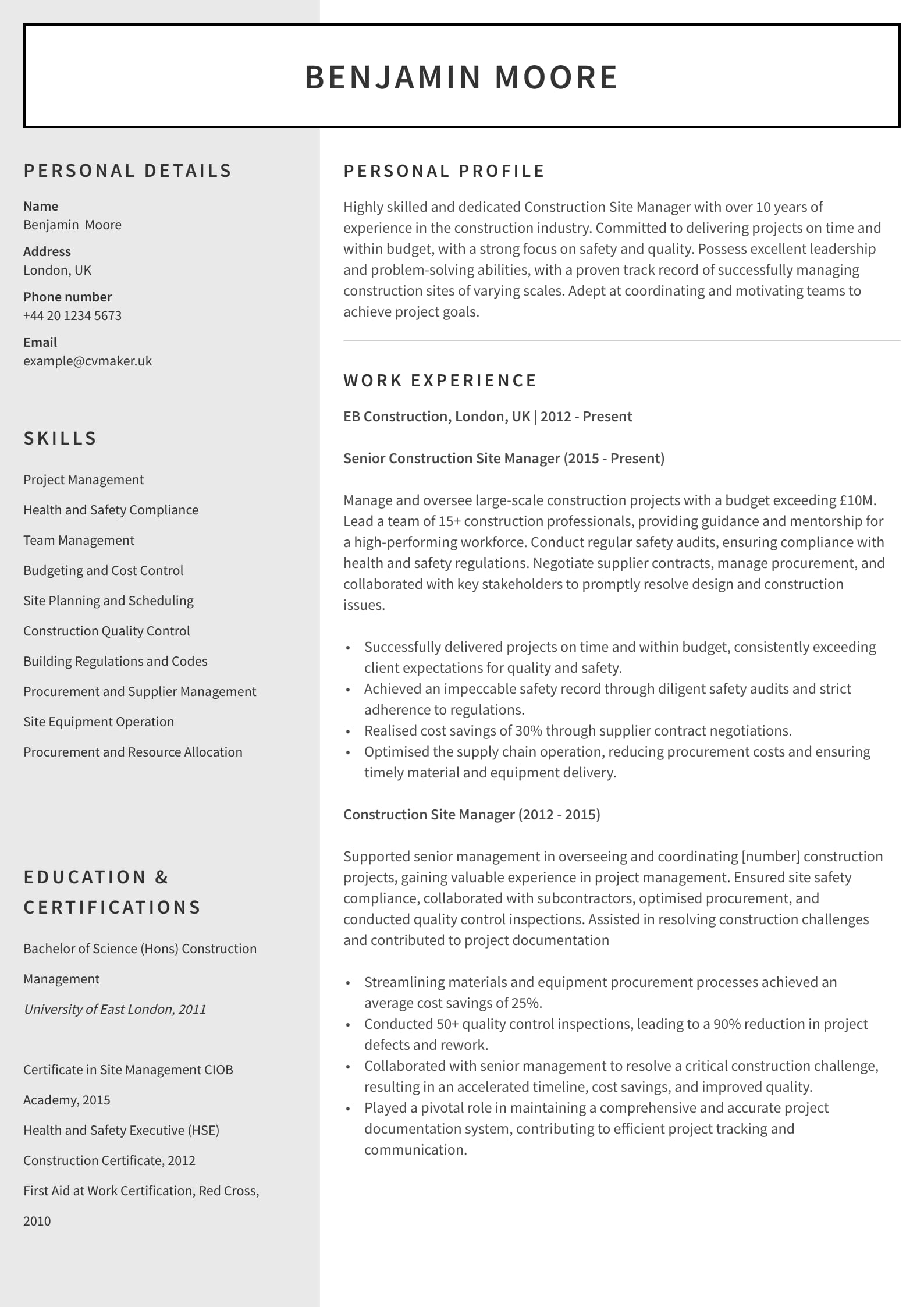
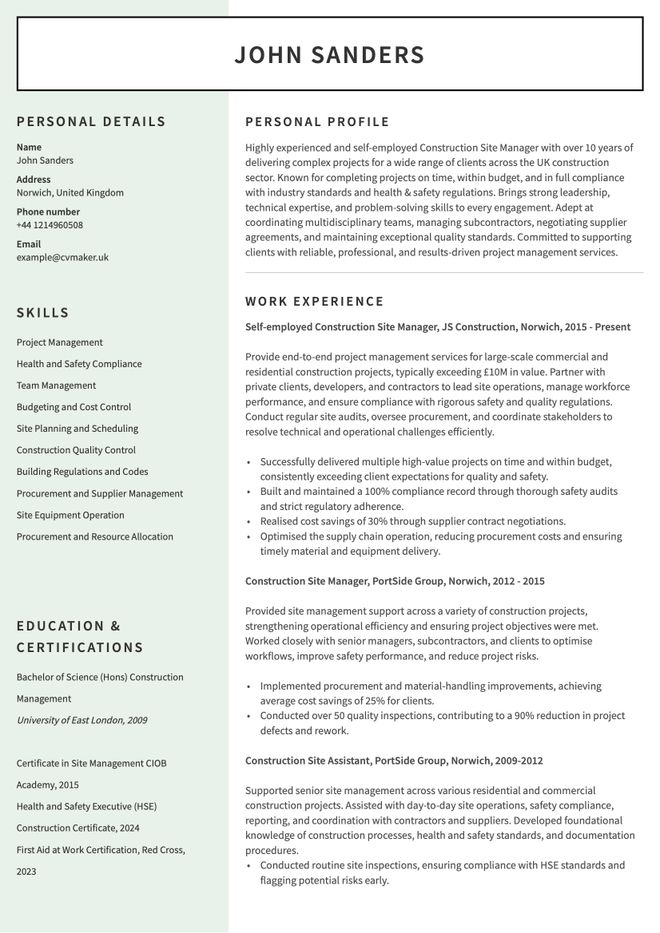
This self employed CV example uses the Auckland template to present freelance and contract experience with clarity and structure. John groups his self-employment under a single role, highlighting measurable achievements and demonstrating his leadership, compliance, and project delivery at scale. John uses a flexible self employed CV sample design that is relevant across industries and can be adapted to different CV templates for UK jobs.
Why do you need a different CV if you’re self-employed
A traditional CV is designed for employed professionals with a clear and consistent work history. A self employed CV must solve different challenges, including:
Multiple clients running at the same time
Short-term, project-based or seasonal work
Confidential contracts where clients cannot be named
Difficulty showing progression or stability
Measuring impact when paid per day or per project.
What to include in a self-employed CV?
Before you start writing, plan your CV using a clear and logical structure. A professional self-employed CV should include:
Contact information: personal details such as your full name, professional email address, phone number, and location
Personal profile: a summary highlighting your services, years of experience and interests
Skills section: a balanced mix of technical, interpersonal and transferable soft skills, tailored to your target role
Work experience: your self-employment history clearly titled and grouped under one role, with bullet points focused on responsibilities and measurable achievements rather than client lists
Education and certifications: relevant qualifications, licences, or industry training
Additional sections: portfolio links, social media profiles such as LinkedIn, client testimonials, and professional memberships.
To get started, create a master CV to summarise all your client collaborations, projects, and achievements. This makes it easier to tailor applications and showcase relevant skills and results.

Must-have CV sections
Personal profile
Skills section
Work experience
Education
If you’re unsure how to structure these sections, read our guide on how to write a good CV.
Keywords to include in a self-employed CV
Using the right keywords in a CV helps hiring managers quickly understand your experience and makes your CV easier to match job requirements. Focus on industry terms that reflect how you work and the services you offer.
Relevant keywords may include:
Consider popular industries for self employed professionals such as and explore these CV examples for more inspiration:
How to format a self-employed CV
Clear formatting helps hiring managers quickly understand your freelance or contract experience. Keep your CV structured and easy to scan by following these guidelines:
Use reverse chronological order to show your most recent work or qualifications first.
Group freelance work under one role (e.g. Self-employed Contractor) to show consistency.
Use clear, recognisable job titles that match the role you’re applying for.
Break content into bullet points to highlight responsibilities and results.
Limit your CV length to 1–2 pages.
Use professional fonts, black/dark grey text and subtle accent colours.
How to list skills in a self-employed CV?
Self-employment develops a wide range of qualities, from technical expertise to creative production, communication, and problem-solving. Your skills section should reflect both your professional strengths and industry-specific experience.
Five essential skills for a self-employed CV
Project management: planning, scheduling, and delivering work across multiple clients, such as software development projects, event planning, or multimedia campaigns.
Problem-solving: resolving issues independently and proactively, such as troubleshooting technical challenges, editing content under tight deadlines, or managing client expectations and negotiating salary.
Communication: building client relationships, providing coaching or consulting guidance, and coordinating PR or social media campaigns.
Time management: prioritising workloads and meeting deadlines across diverse projects, from finance and bookkeeping tasks to videography and content creation.
Commercial awareness: pricing services, budgeting, and delivering value in areas like consulting, marketing campaigns, or tech and creative projects.
Integrate 2–3 soft skills into a results-orientated sentence. For example:
“Self-employed consultant known for clear communication, strong organisation, and problem-solving, delivering projects on time across multiple client engagements.”
| Hard skills | Soft skills |
|---|---|
| Digital bookkeeping | Creativity and innovation |
| Quote structuring | Adaptability and flexibility |
| Negotiation | Client relationship management |
| Digital marketing | Negotiation and persuasion |
| Data and AI literacy | Attention to detail |
| Web development | Critical thinking |
| Reporting dashboards | Self-motivation and initiative |
| Cyber security | Collaboration and teamwork |
| Project management | Resilience |
In the work experience section, show how technical tools or strategic methods led to measurable outcomes. Example:
“Used project scheduling software to coordinate 5 concurrent client projects, reducing delays by 20%.”
How to write a personal profile for a self-employed CV
A CV personal profile is a short, punchy section at the top of your CV that explains how you add value and supports your long-term career goals.
For a self-employed CV, it’s your chance to showcase the top soft skills and transferable skills listed above that demonstrate your ability to work independently and deliver results.
Tips for adding soft and transferable skills:
Use relevant examples: instead of just stating a skill, show how you’ve applied it: “Managed multiple client projects independently, delivering high-quality results on time and within budget.” and “built strong client relationships through clear communication and tailored service delivery.”
Include industry-relevant keywords: research your industry, such as sales, construction, creative design, or beauty and wellness. Highlight skills that align with the role you’re targeting
Keep it concise: aim for 3–5 lines that clearly summarise your experience, strengths, and value to clients or employers.
Self-employed beauty therapist CV personal profile example
Professional self-employed beauty therapist with 5+ years of experience delivering facial, body, and holistic treatments. Skilled in interpersonal communication, customer service, and client retention, with experience managing appointments, upselling services, and running a small business efficiently.
Self-employed builder CV personal profile example
Experienced self-employed builder with 7+ years of experience in domestic and commercial construction projects. Strong problem-solving, project management, and client liaison skills, capable of planning, coordinating teams, and delivering work safely, on time, and within budget.
Self-employed carpenter CV personal profile example
Detail-orientated self-employed carpenter with 6+ years of experience crafting bespoke furniture and fittings. Skilled in project management, communication, and precision work, able to work independently or with subcontractors to provide high-quality, client-focused results.
Self-employed cleaner CV personal profile example
Reliable self-employed cleaner with 4+ years of experience managing residential and commercial contracts. Strong attention to detail, organisational, and time management skills, adept at adapting services to client needs while maintaining high hygiene standards.
Self-employed electrician CV personal profile example
Qualified self-employed electrician with 5+ years of experience in domestic and commercial electrical installations. Experienced in technical problem-solving, client communication, and independent project management, prioritising safe, efficient, and compliant work across multiple sites.
Explore the following CV example and writing guides for more tips:
Work experience to include in a self-employed CV
When listing work experience in a self-employed CV, the main challenge is effectively presenting your skills, achievements, and credibility without the traditional structure of employer-based roles. Here’s how to navigate these challenges:
Define clear job titles: As a self-employed professional, you may wear multiple hats (e.g., project manager, marketer, accountant). Use concise, professional titles that reflect your expertise and align with the role you're targeting.
Showcase credibility: Without a recognisable employer, it's essential to establish trust. Include client testimonials, references, or links to your portfolio to validate your work and demonstrate the quality of your services.
Quantify achievements: Highlight measurable results, such as revenue growth, client retention rates, or successful project outcomes, to make your experience more impactful and tangible.
Prioritise relevance: Self-employed individuals often work on diverse projects. Focus on the most relevant experiences and skills that align with the job or opportunity you're applying for, avoiding unnecessary details.
Address gaps thoughtfully: If there are periods of less work or gaps between projects, frame them positively by showcasing how you used that time for skill development, networking, or other productive activities.
Highlight key projects: Instead of listing every project, emphasise a few standout ones that demonstrate your expertise, problem-solving abilities, and the value you bring to clients.
Balance professionalism and personal branding: Your CV should reflect your unique personal brand while maintaining a professional tone. Use a clean layout and clear language to convey your experience effectively.
By structuring your work experience strategically, focusing on measurable outcomes, and tailoring your CV to the specific role or client, you can create a compelling self-employed CV that stands out.

What should each work experience entry include?
Job title of current or previous role
Organisation name and location
Dates of employment (month/year)
A concise paragraph detailing your duties
Followed by 2–3 bullet points that highlight your key achievements or measurable impact.
Learn more about the work experience section in a CV.
Good versus bad achievement examples for work history
Good
"Managed billing for 20+ clients monthly, improving cash flow and reducing late payments by 30%.”
Bad
“Issued invoices to clients.”
Good
“Provided consultancy services that increased client operational efficiency by 20% through tailored workflow recommendations.”
Bad
“Advised clients on business operations.”
Self-employed CV work experience examples
Freelancer, Various Clients, Remote, 2022 – present
Responsible for delivering freelance services across digital content, marketing support, and client projects. Work closely with business owners to understand objectives, manage briefs, and deliver high-quality outputs that align with brand goals. Balance multiple client deadlines while maintaining consistent standards and clear communication.
Delivered freelance projects for 15+ clients, achieving repeat work from 70% of clients within six months
Introduced structured workflows and client reporting, reducing turnaround times by 25% and improving client satisfaction.
Self-employed Joiner, Manchester, 2020 – 2022
Specialise in bespoke joinery projects for residential clients, including fitted furniture, kitchens, and interior woodwork. Manage projects from initial consultation through to installation, ensuring materials, timelines, and client expectations are met. Maintain high standards of craftsmanship and health and safety compliance.
Completed 40+ joinery projects on time and within budget, with consistent positive client feedback
Improved material planning and measurements, reducing waste and rework by 15% across projects.
Independent Business Consultant, Birmingham, 2021 – present
Provide consultancy services to small and medium-sized businesses, supporting operational improvement, marketing strategy, and process optimisation. Work closely with clients to assess challenges, develop tailored recommendations, and support implementation to achieve measurable results.
Advised 10+ businesses on workflow improvements, increasing operational efficiency by an average of 20%
Delivered strategic planning support that helped clients reduce costs and improve profitability within six months.
How to include education on a self-employed CV
The education section of your CV should support your work experience, not compete with it. List qualifications clearly and concisely, placing this section after work experience unless you are newly qualified or a recent graduate.
How to format educational qualifications
Degree
[Degree title], [Institution], [Location], [Year of graduation]
Bachelor of Arts in English Literature, University of Leeds, UK, 2021.
A-Levels
[Qualification name], [Institution], [Location], [Years completed]
English Language, Media Studies, Business, Leeds City College, UK, 2018.
GCSEs
[Qualification name], [Institution], [Location], [Year completed]
10 GCSEs with grades 5–7, including English Language and Mathematics, Leeds High School, UK, 2022.

Tips for self-employed professionals:
Include education that supports how you run your business, such as apprenticeships or internships.
List short courses, certifications, or licences that show compliance, professionalism, or specialist knowledge.
Essentials for a self-employed CV
Present your self-employed experience clearly by focusing on outcomes, client results, and the value you delivered, rather than daily tasks. Balance technical expertise with transferable skills to show how you work across different clients and projects. Include relevant training, certifications, or licences to demonstrate credibility and continued professional development. Tailor your CV for each role or contract, and support your experience with links to portfolios, case studies, or references.
Dos and don’ts for a [job title] CV
Dos
Focus on results, outcomes, and client impact
Group similar contracts under one self-employed role
Use clear job titles that match the role you’re applying for
Keep formatting simple and ATS-friendly.
Don’ts
List duties without showing value or results
Include every short contract if it adds no relevance.
Use informal language or client jargon
Leave unexplained gaps or unclear timelines.
Next steps?
Boost your job search by exploring average UK salaries, top remote jobs, and the most influential industries to learn where your skills are in demand. Strengthen connections through networking and support your job applications with a tailored cover letter.
FAQs
How can I add clients if I can’t name them?
Use anonymised descriptions such as “private client” or “SME client” and focus on outcomes.
Do I need a CV if I’m self-employed?
Yes. Many employers and agencies still require a CV to assess experience and skills.
Should I tailor my CV for each job?
Yes. Adjust job titles, skills, and achievements to match the role.
Do I need references?
Not always, but client testimonials or “references available on request” are acceptable.
How do I manage short gaps in work?
Group contracts together or briefly explain gaps with training, travel, or business development. Need help explaining gaps in employment between contracts? Refer to our guides on unemployment, navigating a career break or maternity leave for tips.