
How to Write a CV for an Internship (Examples & Expert Tips)
Most internship applicants share the same worry: how do I fill a CV when I haven't had a "proper" job yet? The good news is that employers don't expect years of experience from interns. They want to see potential, a willingness to learn, and proof that you can apply your skills.
This guide includes a full UK internship CV example to show you what that proof looks like on paper. You'll learn:
What to include in an internship CV, section by section
How to write a personal profile that fits the role
How to turn coursework, projects, part-time jobs, and societies into measurable achievements
How to tailor your CV for summer internships, placement years, and graduate internships
By the end, you'll know how to build a focused, ATS-friendly CV for an internship, even if your work history is short.
Create a professional internship CV in minutes with CVMaker and our customisable CV templates.

Internship CV example
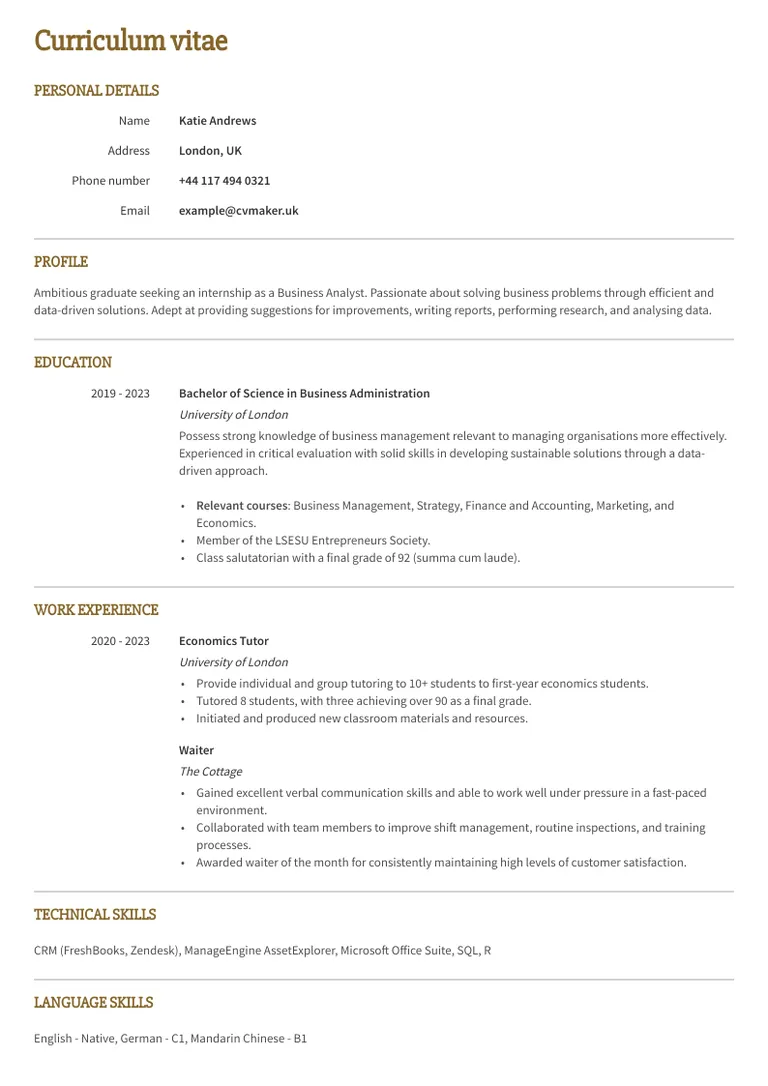
Download this CV example - Internship CV.
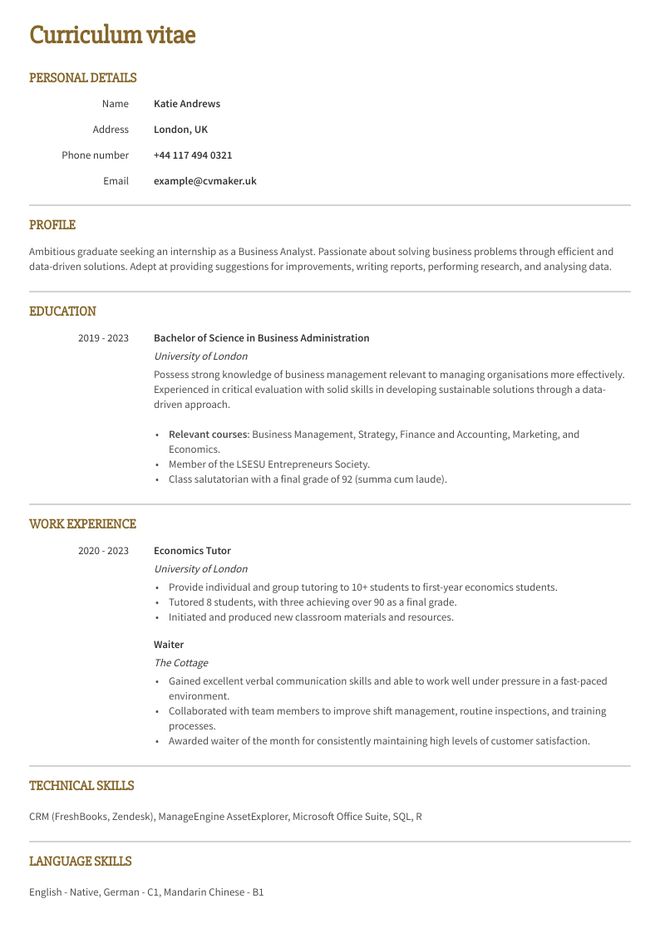
Katie Andrews is a recent graduate looking to kickstart a career through an internship. With the Princeton CV template, she showcases her experience through education and side jobs while drawing attention to her technical and language skills.
Why this internship CV works
It leads with relevance. The profile names the target role and links her skills directly to it.
Education sits near the top. With limited work history, her degree and modules carry more weight.
Every bullet shows a result. Numbers like "42% follower growth" and "£1,200 raised" turn everyday tasks into evidence.
Non-work experience counts. Her society role and personal project show marketing skills more clearly than her retail job.
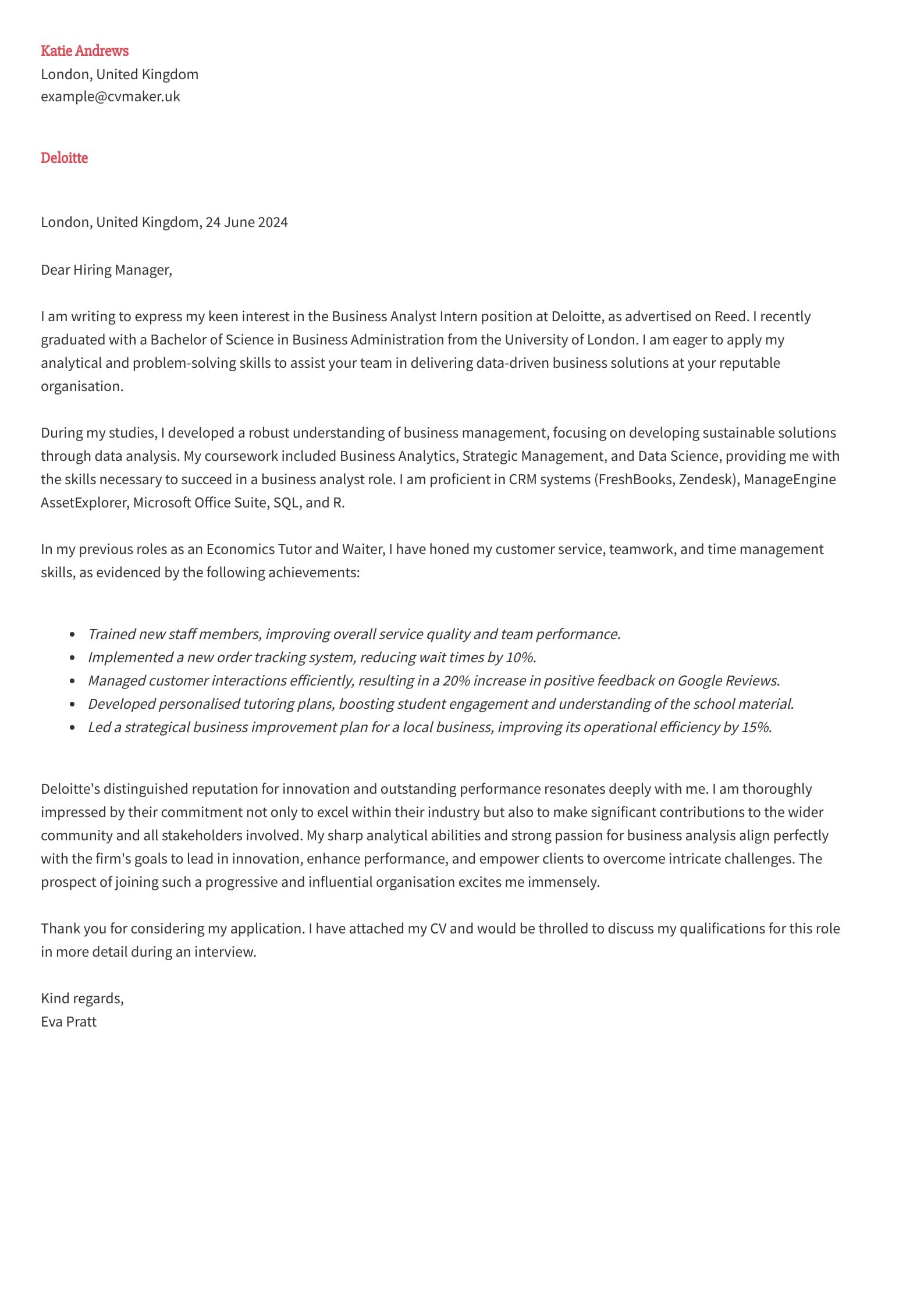
Need a cover letter? Refer to our matching internship cover letter example for more valuable insights and tips to help you succeed in your next job.
What to include in an internship CV?
A UK internship CV is usually one page, or two at most. Use clear headings and a simple layout so recruiters can find key details in seconds. Always read the internship description first, then shape each section around what the employer asks for.
| CV section | When to include it | What to add |
|---|---|---|
| Contact details | Always ✔ | Your name, phone number, professional email address and town or city. Add a LinkedIn, portfolio or GitHub link if it supports your application. |
| Personal profile | Always ✔ | Two or three sentences introducing what you study or recently studied, the internship you’re applying for and what you can bring to the role. |
| Education | Always ✔ | Your qualifications, institution and dates. Add your expected graduation date if you’re still studying, plus relevant modules or coursework. |
| Skills | Always ✔ | Skills that match the internship description, such as data analysis, report writing or Excel. Show how you used them in your experience or projects. |
| Work and volunteering experience | If you have it | Part-time jobs, placements, volunteering or society roles. Use short bullet points to show what you did and what you achieved. |
| Projects | If they demonstrate relevant skills | Academic, personal or group projects. Briefly explain what you made, researched or delivered and what you contributed. |
| Courses, certificates and achievements | If relevant to the role | Short courses, certifications, awards or competition results that support your application. |
What to leave out: In the UK, you don't need a photo, date of birth, marital status, or your full home address. You can also skip "References available upon request", as employers will ask if they need them.
Pro tip
Before jumping into writing, we recommend getting to know the company culture and brand personality to find out what kind of organisation you’re communicating with. Doing so gives you more insight into what information to include in your CV and, eventually, helps you land a job interview.
How to write a personal profile for an internship CV
Your CV personal profile is a short paragraph at the top of your document. It tells the employer who you are, what you offer, and what you're looking for. For internships, it's your chance to show focus and enthusiasm before the reader reaches your experience.
Personal profile tips:
Start with your current status, such as your degree, year of study, and university.
Mention two or three skills that match the internship description.
Add one piece of evidence, such as a project, society role, or result.
Finish with the type of internship you're targeting and when you're available.
Summer internship personal profile example
Penultimate-year BSc Economics student at the University of Bristol with strong analytical and research skills. Completed a group project modelling regional housing prices in Excel, achieving a grade of 74%. Treasurer of the Investment Society, managing a £5,000 student portfolio. Seeking a 10-week summer internship in financial services from June 2027.
Placement year personal profile example
Second-year BSc Computer Science student at the University of Manchester seeking a 12-month industrial placement in software development. Skilled in Python, JavaScript, and SQL, with hands-on experience building a web app that helps students track deadlines, now used by 150 classmates. Placed in the top three of 20 teams at a university hackathon. Available from July 2027.
Graduate internship personal profile example
Recent BA (Hons) English Literature graduate (2:1) from the University of Nottingham with experience in writing, editing, and content planning. Wrote 30 articles for the student newspaper, including two that reached over 5,000 readers online. Looking for a graduate internship in publishing or communications to build on strong research and storytelling skills.
How to include skills in an internship CV
Your skills CV section should show employers you can contribute from day one and learn quickly. Interns are often judged on potential, so soft skills matter just as much as technical ones. The key is to back them up with evidence elsewhere in your CV.
Five essential skills for internship applicants
Communication: Writing clear emails, presenting ideas, and speaking confidently with colleagues.
Teamwork: Working well on group projects, in society committees, or with shift teams.
Time management: Balancing studies, part-time work, and other commitments.
Adaptability: Picking up new tools and processes quickly.
Digital skills: Using software relevant to your field, from Excel to design or coding tools.
Pro TIp
Match your skills to the keywords in the internship advert. If the role asks for "stakeholder communication" and "Excel", use those exact terms where they're true for you. This also helps your CV pass ATS checks.
| Soft skills | Hard skills |
|---|---|
| Communication | Microsoft Excel and PowerPoint |
| Teamwork | Data analysis |
| Problem-solving | Social media management |
| Time management | Design software (such as Canva or Adobe) |
| Initiative | Coding languages (such as Python or SQL) |
| Adaptability | Research and report writing |
| Attention to detail | Foreign languages |
| Leadership | Industry-specific tools |
For more useful tips, explore our related blog article on top skills employers look for.
How to include work experience on an internship CV
Any job can strengthen your internship CV if you focus on what you achieved, not just what you did. A café shift or retail role builds skills that employers value, like reliability, communication, and working under pressure. Knowing how to effectively add the work experience CV section is key.
Follow these steps:
List your most recent role first and work backwards.
Add your job title, employer, location, dates, and hours if part-time.
Write two to four bullet points per role, starting each with an action verb.
Include numbers wherever you can: customers served, money raised, time saved, or targets met.
Highlight skills that link to the internship.
Weak vs strong bullet points
Strong
Served up to 150 customers per shift during peak hours while keeping average wait times under five minutes
Coordinated promotion and registration for three student events attended by 240 participants
Grew society Instagram followers by 42% in six months through a weekly content calendar
Sorted and priced donations, helping increase weekly sales by 15% over a summer
Weak
Worked in a café
Helped organise university events
Did social media for a society
Volunteered at a charity shop
For more advice, please refer to our blog article on entering the workforce after graduation.
Examples of work experience for an internship:
Marketing Intern | Red Bull, London, UK | 2023-2024
Assisted in developing and executing marketing campaigns, ensuring all initiatives were aligned with brand objectives.Analysed market trends and consumer behaviour to inform strategic decisions and optimise marketing efforts. Coordinated promotional events and activations, managing logistics and vendor relations. Collaborated with the design team to create compelling visual content for various social media platforms.
Assisted the Head of Marketing in a campaign that boosted sales by 15% in the first month, significantly exceeding initial targets.
Increased social media engagement by 20% through targeted content and strategic use of trending hashtags.
Successfully managed event logistics for a product launch, attracting over 500 attendees and generating extensive media coverage.
For more expert examples and tips, refer to our marketing CV and marketing cover letter examples.
Software Development Intern | Google, London, UK | 2022-2023
Participated in the development of new software features, working closely with senior developers to learn best practices. Conducted code reviews and debugging sessions to ensure the quality and functionality of software. Engaged in daily stand-ups and sprint planning to stay on track with project milestones and team goals. Presented project findings to senior management, showcasing the progress and impact of the developed features.
Implemented algorithms improving process efficiency by 20%, enhancing overall system performance.
Reduced system errors by 15% through effective debugging and thorough testing procedures.
Delivered a final project showcasing impactful developments, receiving positive feedback from senior engineers for innovation and functionality.
See our (software) developer CV and developer cover letter examples to learn more.
How to write education for an internship CV
For most internship applicants, the strongest CV section is education. Place it near the top of your CV, directly under your personal profile, unless you have substantial relevant work experience.
What to include:
Degree title, university, and dates (add "expected" if you're still studying)
Your current or predicted grade
Relevant modules that match the internship
Dissertation or major projects, with grades if strong
A Levels or equivalent, plus GCSEs if you're early in your studies
If you're applying for a placement year, highlight modules and practical work linked to the role. For a graduate internship, lead with your final degree classification and dissertation.
Key takeaways
An internship is valuable for anyone just starting out in their career, but what’s even more important is ensuring your CV is set up the right way. With our expert tips and examples on which sections to include, you can be certain that you will start landing more interviews.
Final tips tips on landing an internship:
Be clear and concise when writing your CV or cover letter.
Use professional language without personal pronouns (‘I’, ‘me’, ‘us’).
Expand your network and use your existing connections.
Seek out feedback from experienced people.
Focus on entry-level jobs or internships to kickstart your career.
Use relevant CV sections and keywords.
Proofread your CV regularly.
Avoid outdated information.
Don’t lie about your skills, education, or experience.
Next steps?
We offer a diverse range of professional templates designed to streamline your job search. Our career platform features a built-in job finder and application tools, alongside a dedicated CV Writing Service. If you need more inspiration, explore our diverse collection of CV examples. Visit CVMaker for more valuable resources and expert career advice to enhance your application success.
FAQ
How do I write an internship CV with no experience?
Focus on what you have done, not what you haven't. Use coursework, group projects, society roles, volunteering, part-time jobs, and personal projects to show your skills. Put education near the top and add measurable results to each entry. Our guide on how to write a CV with no experience has more tips.
How long should an internship CV be?
Aim for one page. If you have plenty of relevant projects, roles, or previous internships, two pages is fine. Cut anything that doesn't support your application for the specific role.
Should I include my part-time job on an internship CV?
Yes. Part-time work shows reliability, time management, and customer skills. Describe it in a way that links to the internship, such as handling pressure, working in a team, or meeting targets.
Should I mention my right to work in the UK?
If you're an international student or graduate, it can help to state your work eligibility clearly, either on your CV or in your cover letter. A short line is enough, for example: "Eligible to work in the UK under current Student visa conditions." Always check the rules for your own visa before applying.
What's the difference between a student CV and an internship CV?
A student CV is often general and used for part-time or casual work. An internship CV is more targeted, focusing on skills, projects, and interests linked to a specific industry or role. For graduate-level roles, see our graduate CV example.
When should I start applying for internships?
Many large employers open summer internship applications between September and December of the previous year. Have your CV ready early so you can apply as soon as programmes open, since some close before the stated deadline.
How to kickstart your career through an internship?
Internships help you get practical experience and teach you valuable skills on how to perform a specific job.
Acquire soft and hard skills to perform a specific job.
User your personal profile to show your motivation to learn and passion for the field.
Demonstrate strong qualifties lke a strong work ethic, a willingness to learn, and a passion for the field.
Meet industry professionals and experienced candidates who can review your career documents.
Regularly update your CV and cover letter to improve your chances of getting noticed.
Lastly, following an internship enables you to meet new people and familiarise yourself with the organisation and office environment.
Where can you apply for an internship?
Consider attending and networking at job fairs to scout for potential employers, or consider career platforms such as CVMaker, Indeed, LinkedIn, or Glassdoor. We recommend looking at the company’s website page to compare the same job post on different platforms.
How to choose the best CV template for an internship?
The CV template choice differs from person to person. Regardless of experience and the type of job you’re interested in, remember your CV layout needs to align with your career goals. The most common way to do it is to use a chronological CV where you first list the most recent experience in reverse chronological order. Another way to do it is to write a skills-based CV better suited for candidates who lack relevant experience and are new to the industry.
How much do interns get paid in the UK?
According to Talent, the average salary interns earn in the UK is £23,300 per year or £11.95 per hour. The lowest job level positions start at £21 060 per year, whereas the highest job level positions have a salary of up to £30 000 per year. The only exception is job shadowing, where an employer does not have to pay the minimum wage.
Explore our related article about the highest-paying jobs in the UK for information on the average salary in the UK and job prospects for those with no experience.