
How to Write a Healthcare CV: Examples and Tips for Success
Use this healthcare CV example to see how to present your patient care experience, qualifications and skills for UK healthcare roles. Explore a sample CV and section-by-section guidance, including professional registration and NHS applications. Learn how to create an applicant tracking system (ATS)-friendly CV with clear formatting and relevant keywords from the job description.
Healthcare CV example
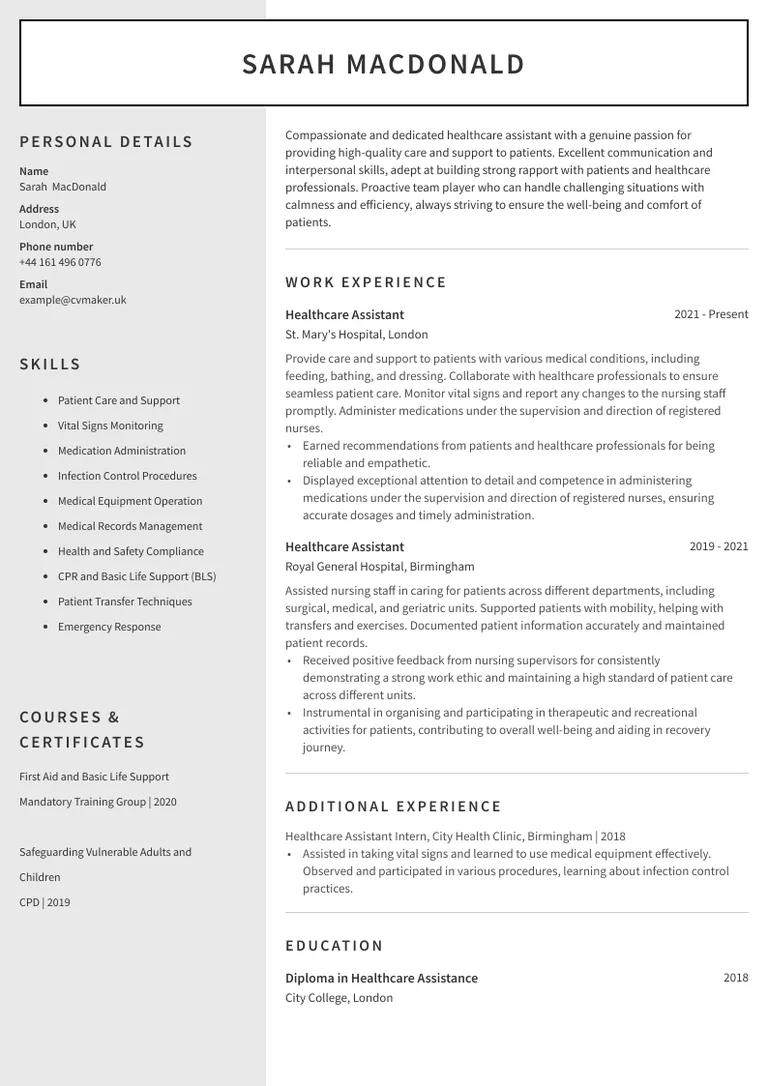
Download this healthcare assistant CV sample PDF
This CV keeps everything a recruiter needs on the first page: professional details, a focused personal profile, and recent patient care experience. The layout is clean and easy to scan, and each section is clearly labelled. Use it as a model, then adapt each section with the guidance below.

What to include in a healthcare CV?
Healthcare recruiters or hiring managers scan for certain details first, such as registration, DBS status, and clinical experience. Use this order to make those details easy to find in your application:
| Section | What to include |
|---|---|
| Personal details and professional registration | Include your name, phone number, professional email and town or city. Add your professional registration number and status (NMC, HCPC or GMC) where applicable, plus relevant Disclosure and Barring Service (DBS) check status if held and appropriate to the vacancy. |
| Personal profile | A short introduction covering your role, care setting, relevant strengths and what you can contribute. |
| Work experience | Your most recent role first, followed by earlier employment, placements or volunteering, with duties and achievements relevant to the vacancy. |
| Education and qualifications | Your relevant qualification, institution and completion date, including an expected completion date if you are still studying. |
| Courses and certifications | Recent role-specific training, mandatory learning and continuing professional development (CPD), with providers and completion dates. |
| Skills | A focused selection of clinical, interpersonal and digital skills that you can demonstrate through your work or training. |
How to write a personal profile on a healthcare CV
In a CV personal profile, write three or four concise sentences explaining your experience, care setting and most relevant skills. Match the vacancy and show how you support safe, respectful care. Avoid unsupported claims such as 'excellent at everything'.
| Experience level | What to include |
|---|---|
| Entry-level | Highlight transferable skills and willingness to learn without claiming clinical experience. |
| Mid-level | Show your care experience, practical skills and contribution to the wider team. |
| Senior | Emphasise leadership, mentoring and service improvement within your scope of practice. |
Personal profile examples for a healthcare CV
Entry-level healthcare personal profile example
Patient and reliable applicant seeking an entry-level Healthcare Assistant role. Brings strong communication and teamwork skills developed through customer service and community volunteering. Committed to completing relevant training and supporting patients with dignity, compassion and respect under the guidance of experienced staff.
Mid-level healthcare personal profile example
Dedicated healthcare professional with four years of experience supporting patient care in busy clinical settings. Skilled in maintaining accurate records, communicating with patients and families, and collaborating with multidisciplinary teams. Recognises changing patient needs and responds appropriately within professional responsibilities.
Senior healthcare personal profile example
Experienced healthcare professional with ten years of experience in patient care, team leadership and service improvement. Skilled in coordinating services, mentoring colleagues and supporting quality and safety standards. Uses patient feedback and performance data to improve care delivery and build effective multidisciplinary teams.
Pro Tip
If you have no healthcare experience, highlight relevant volunteering, caring responsibilities or customer service work. Explain the transferable skills you developed and distinguish these from clinical tasks you have not yet been trained to perform.
What skills to include for an ATS-friendly healthcare CV
Use the job description to identify the clinical, interpersonal and digital skills the employer needs. Include those that match your training and experience, using the employer’s terminology where appropriate.
Support key skills in your CV with examples from your work, placements or relevant experience. For senior roles, highlight relevant leadership, specialist expertise and service improvements.
| Soft skills | Clinical skills | Hard skills |
|---|---|---|
| Communication | Personal care | Electronic health records (EHR), such as SystmOne or EMIS |
| Active listening | Vital signs monitoring | Digital documentation |
| Empathy | Infection prevention and control | Telehealth platforms |
| Teamwork | Basic life support | Digital patient monitoring |
| Adapability | Phlebotomy or wound care | Appointment, referral or laboratory systems |
| Confidentiality | Medication administration | Secure information handling |
Pro tip
Choose standard headings, a readable font and the file type requested by the employer; avoid putting essential information only in icons, images or graphics.
How to write work experience on a CV for a healthcare professional
For each CV work experience entry, include your job title, employer, location and month/year dates. Add a short description of your responsibilities, followed by specific achievements using action verbs. Keep clinical duties within your training, assessed competence and level of supervision.
Use action, context and outcome to structure your points. For example, explain how a handover checklist improved communication or how a clearer appointment process reduced delays. Use patient satisfaction, caseload or waiting-time figures only when you can substantiate them, and never include identifiable patient information.
The following illustrative entries form a non-overlapping, three-year timeline. Replace the employers, dates and results with your own details.
Patient-focused achievements in a CV do not always need a percentage. Helping someone communicate their preferences or improving the clarity of a handover can be valuable evidence when you explain your contribution and its outcome.
Examples of work experience:
Senior Healthcare Specialist | Vitality Healthcare Center, London | 2016 - 2021
Led a team of care professionals, coordinating patient care plans and implementing quality improvement initiatives. Conducted in-depth medical assessments, diagnosed complex cases, and prescribed appropriate treatments. Recognised for outstanding patient outcomes and dedication to maintaining the highest standards of care.
Led and mentored a team of 15 care professionals, resulting in improved patient care and increased staff morale.
Implemented a quality improvement program that reduced patient wait times by 20%, leading to higher patient satisfaction scores.
Received the "Outstanding Leadership Award" for exceptional contributions to patient care and innovative problem-solving.
Emergency Healthcare Assistant | Life Ambulance Services, London | 2019 - 2021
Responded to emergency calls, providing immediate medical assistance and ensuring patients' safety during transportation. Assisted paramedics with medical equipment, procedures, and patient assessments. Demonstrated quick decision-making skills and a calm demeanour during high-pressure situations.
Responded to over 200 emergency calls and provided immediate medical assistance.
Assisted in resuscitating a critically ill patient and demonstrated effective teamwork and life-saving skills.
Recognised for exceptional performance with the "Life Saver Award" for quick and decisive action during a challenging emergency.
Healthcare Assistant | City Hospital, London | 2022 - Present
Provide compassionate care and support to patients in various departments. Assist care professionals with patient assessments, vital sign monitoring, and medication administration. Collaborate with the nursing team to ensure a safe and comfortable patient environment.
Assisted in caring for more than 500 patients, ensuring their comfort and safety throughout their hospital stay.
Completed training in medication administration and achieved a 100% accuracy rate in drug dispensation.
Received positive feedback from patients and their families received positive feedback for providing compassionate and attentive care.
How to list education on a healthcare CV
List relevant education history in your CV in reverse chronological order. Include the exact award title, institution and dates. Use UK qualification names where these are your actual awards; if you qualified overseas, keep the original title and describe any formally recognised equivalence accurately.
Examples for different routes include:
For nursing roles: BSc (Hons) Adult Nursing | [University] | [Completion year]; list Nursing and Midwifery Council registration separately
For doctor roles: MBBS or MBChB | [Medical school] | [Completion year]; use the exact qualification awarded and list General Medical Council registration separately
For allied health roles: BSc (Hons) Physiotherapy | [University] | [Completion year]; include Health and Care Professions Council registration where required
For an apprenticeship route: Healthcare Support Worker apprenticeship | [Employer and training provider] | [Completion year]
For placements or internships: [Placement title] | [Organisation] | [Dates]; place this under experience rather than presenting it as a qualification
Pro Tip
Prioritise listing the most recent and significant qualifications that align with the roles you're applying for. If you are a student writing a CV with only secondary-tier education, consider completing a course or internship to enhance your application.
If you’re ambitious to kickstart your career in care, discover the available UK apprenticeship levels and over 350 different career choices with the NHS. In addition, learn more about working in the health and social care career and its latest education requirements or refer to our apprenticeship CV example article.
How to list courses and certifications
Keep the courses and certificates in your CV relevant to the job description. Give the course title, training provider and completion date. Include a renewal or refresher date only where the provider or employer specifies one.
Useful training to list, if completed, includes:
Basic life support and resuscitation training appropriate to your role
Infection prevention and control
Adult or child safeguarding at the required level
Moving and handling or safer patient transfers
Medicines training relevant to your authorised responsibilities
Dementia awareness, palliative care or another relevant specialism
Example format: Name of course, Level [completed level] | [Training provider] | [Month year]
Include recent CPD that relates to the post, such as a workshop, supervised learning activity or quality improvement training. Briefly explain its relevance if the title is unclear. This helps demonstrate ongoing development for both support and registered roles, including NHS Band 5 and above positions.
NHS-specific CV requirements
Follow the application instructions: Many NHS vacancies use an application form and supporting information rather than accepting a CV alone. Address each essential criterion in the person specification, with evidence, and follow the stated word or character limits.
Demonstrate NHS values: For roles in England, the NHS Constitution values include working together for patients, respect and dignity, commitment to quality of care, compassion, improving lives and everyone counts. Show these through actions. Check the organisation's own values, especially when applying elsewhere in the UK.
Use the 6Cs appropriately: Care, compassion, competence, communication, courage and commitment are the 6Cs of care. They complement the NHS Constitution values but are a separate framework; use relevant examples rather than simply listing either set of terms.
Match the role and band: State your current Agenda for Change band if relevant and accurate. Describe responsibilities that demonstrate the advertised competencies, referring to the NHS Knowledge and Skills Framework where the vacancy uses it. Bands reflect evaluated roles, not qualifications alone; doctors use separate pay arrangements.
Make registration easy to find: Where required, list the Nursing and Midwifery Council (NMC) PIN, Health and Care Professions Council (HCPC) registration number or General Medical Council (GMC) reference number near your contact details or in a registration section. State your actual status; do not imply that all healthcare assistants require professional registration.
Describe checks accurately: If true, write 'Enhanced DBS held; issued [month/year]' and mention Update Service subscription only if applicable. A certificate has no official expiry date and the employer decides what further checks are needed. Scotland and Northern Ireland use different disclosure systems. Share certificate details through the employer's secure process, rather than attaching them to a general CV.
Once your application is ready, prepare examples for your supporting statement and interview using our NHS interview questions guide.
Healthcare CV examples and writing guides by role
Use these guides for advice specific to your profession and scope of practice.
Nurse CV example: highlight your registration, placements, clinical setting and nursing achievements
Doctor CV example: organise medical training, clinical appointments and relevant professional activity
GP CV example: focus on primary care experience, patient continuity and practice responsibilities
Care assistant CV example: present personal care skills, safeguarding knowledge and support experience
Paramedic CV example: explore an allied health example covering emergency response and clinical practice
Midwife CV example: tailor your maternity care experience and NMC registration details
Support worker CV example: demonstrate person-centred support, communication and relevant care settings
Key takeaways
Tailor your profile to the role, care setting and person specification.
Make relevant professional registration and check status easy to find.
Select clinical, interpersonal and digital skills you can demonstrate.
Show patient-centred outcomes while respecting confidentiality and your scope of practice.
Include relevant qualifications, recent training and CPD.
Use clear formatting and check that dates, duties and achievements are consistent throughout.
Next steps?
For healthcare professionals aspiring to advance their careers or improve their CV, explore our selection of over 20+ professional CV templates, easily tailored to your career goals. Our CV Writing Service can also save you time and effort if you are writing a CV with no experience. In addition, to enhance your job application further, we recommend familiarising yourself with how to start a cover letter to make the best impression on potential employers and land your dream role.
FAQs
What format and length should a UK healthcare CV use?
Use clear headings and reverse chronological employment and education sections. A one or two page CV is a useful target for many support and nursing roles, but medical or academic posts may need more detail. Follow the vacancy's instructions, including any separate application form or document requirements.
How do I write a healthcare CV with no experience?
Prioritise relevant education, placements, volunteering and transferable skills. Use examples of communication, reliability and supporting others from work, study or caring responsibilities. State what you have learned and what training you are ready to complete, without claiming clinical competence you have not gained. Learn more about how to write a CV with no experience.
What should a healthcare CV professional statement include?
A personal profile or professional statement should briefly explain your background, relevant skills and intended role. Mention the care setting and one or two strengths supported by your experience. A short CV profile is different from the longer supporting statement an NHS application may request.
Do I need to include my NMC or HCPC registration number on my CV?
Include your regulator and registration status when the role requires registration, adding your NMC PIN or HCPC number where requested or useful for the application. Doctors can include their GMC reference number. Healthcare assistants should not add a registration number unless they hold a relevant registration. Employers verify status separately.
How do I tailor my healthcare CV for an NHS application?
Read the job description and requirements, then match your evidence to the essential criteria. Use relevant terminology, demonstrate the organisation's values through examples and check registration and training requirements. If the vacancy asks for supporting information, complete it separately rather than submitting your CV in its place.
What is the average salary of a healthcare assistant in the UK?
The average salary of a healthcare assistant in the UK ranges from £20,000 to £30,000 per year. Salaries can vary depending on location, level of experience, and the specific setting.
Additionally, check out our related blog article on the highest-paying jobs in the UK for more information on career prospects and average salary for healthcare roles.