
How to Write a Graduate CV: Step-by-Step Guide with Examples and Tips
Starting your career after university is exciting, but it’s also full of twists and turns, especially in today's UK job market. According to the latest ONS figures, 22.5% of people aged 16 to 24 cannot find work, so you’re not alone if it all feels a bit daunting. It’s a landscape where in-demand fields like data analytics, technology, sustainability, and healthcare offer plenty of chances for growth, but competition for entry-level roles is higher than ever.
Many graduates struggle to get past the initial screening stages simply because their CVs are not formatted correctly or lack specific evidence of their skills. The good news? Understanding this modern hiring process and how to navigate it will help you stand out
This guide walks you through the exact steps to create a CV that stands out to hiring managers and automated systems alike. We will cover how to format your document, how to structure your experience, and how to overcome common hurdles like having no direct work experience.
Here is what you will learn:
How to format your CV for applicant tracking systems (ATS).
How to write achievements using the STAR-O framework.
The most common mistakes graduates make on their CVs.
How to highlight micro-credentials and university projects.
What a professional graduate CV template matters.
Discover our free CV checklist: No experience edition at the end of the article!

Graduate CV examples
Different industries look for different signals in a graduate CV. Tailoring your approach to your specific sector is crucial for success. Explore these graduate CV examples that you can customise for your next job application.
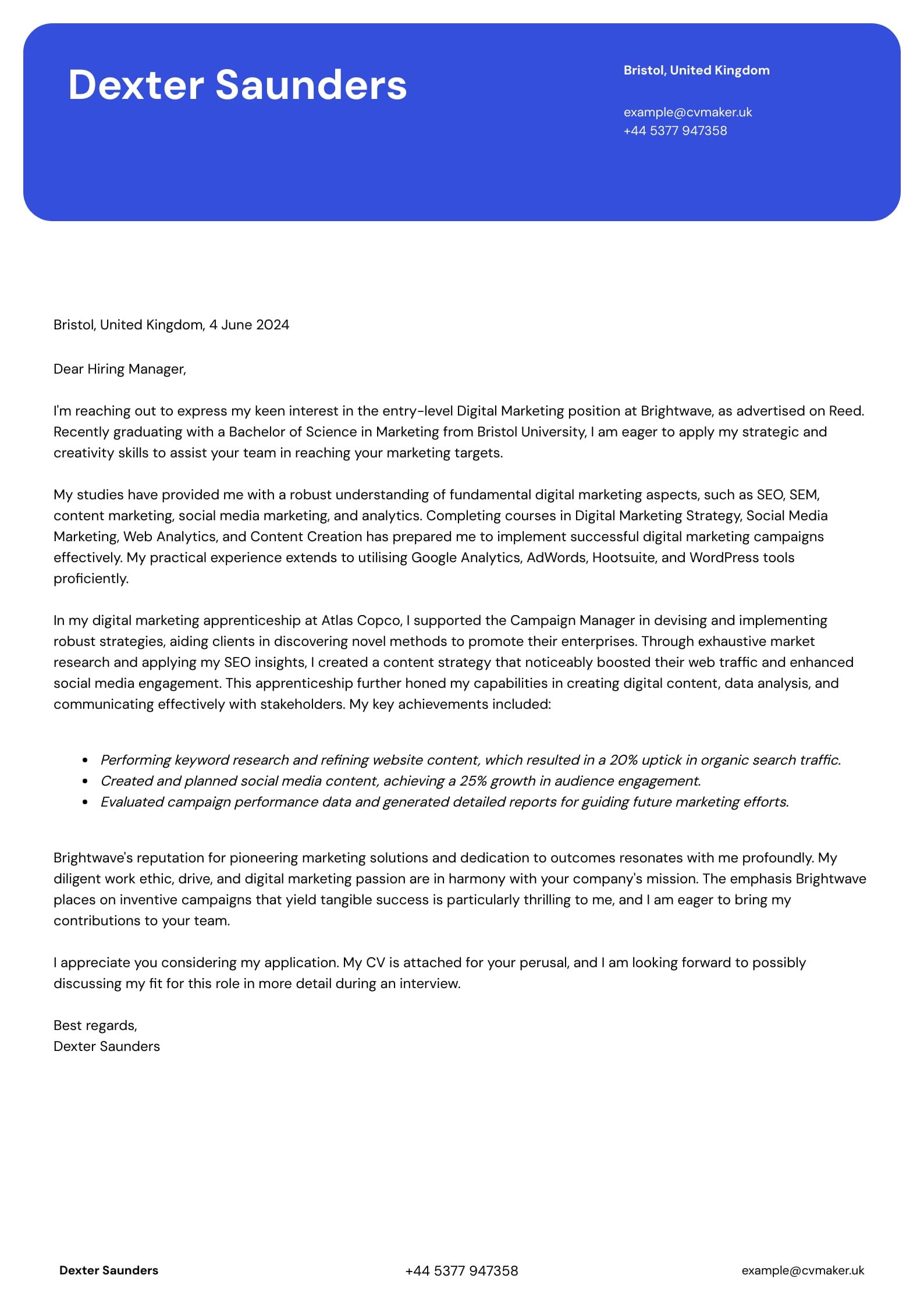
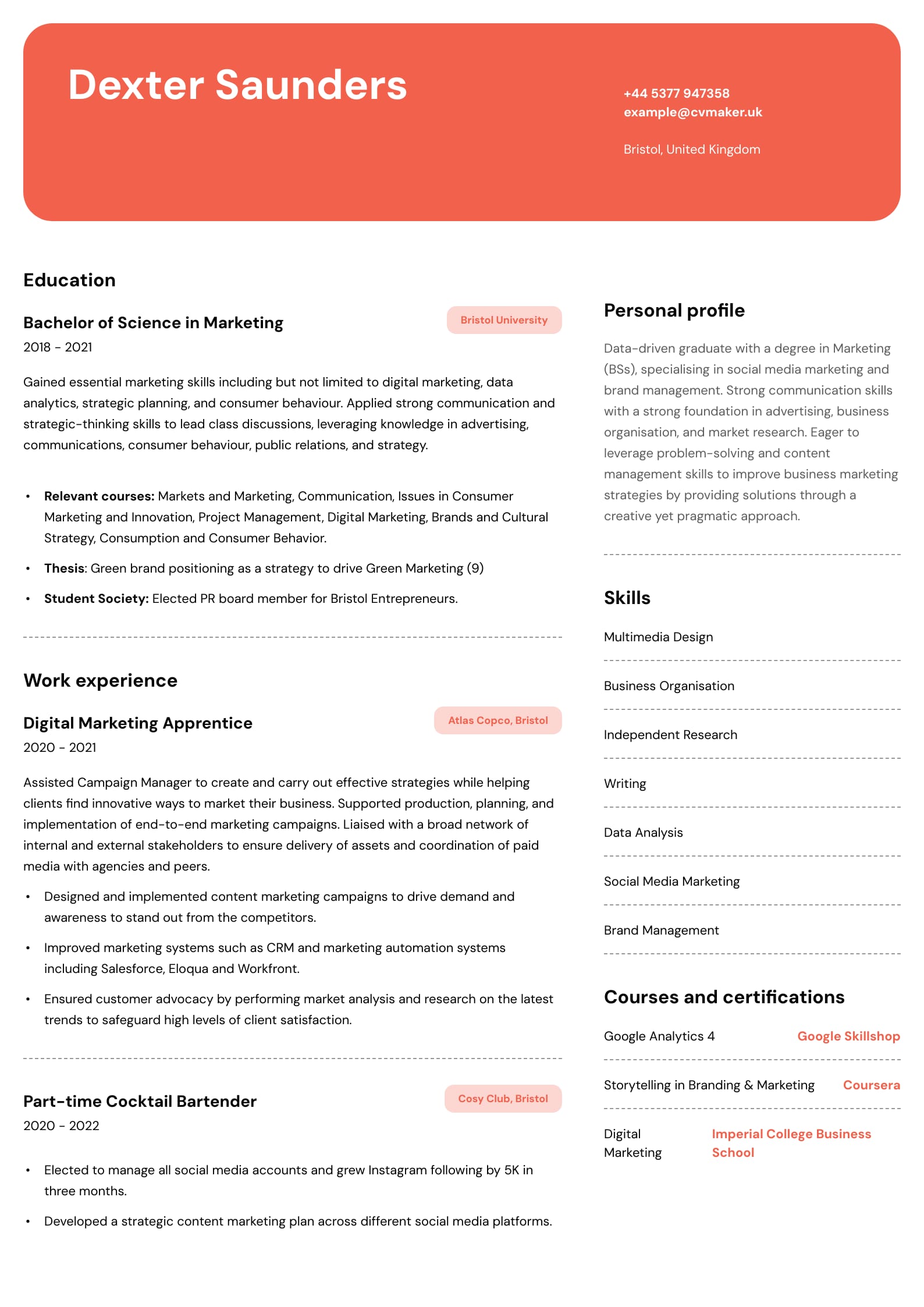
Marketing graduate CV example
) Download this CV example - Graduate CV
Download this CV example - Graduate CV
Accounting graduate CV example
) Download this accountant CV example free in PDF.
Download this accountant CV example free in PDF.
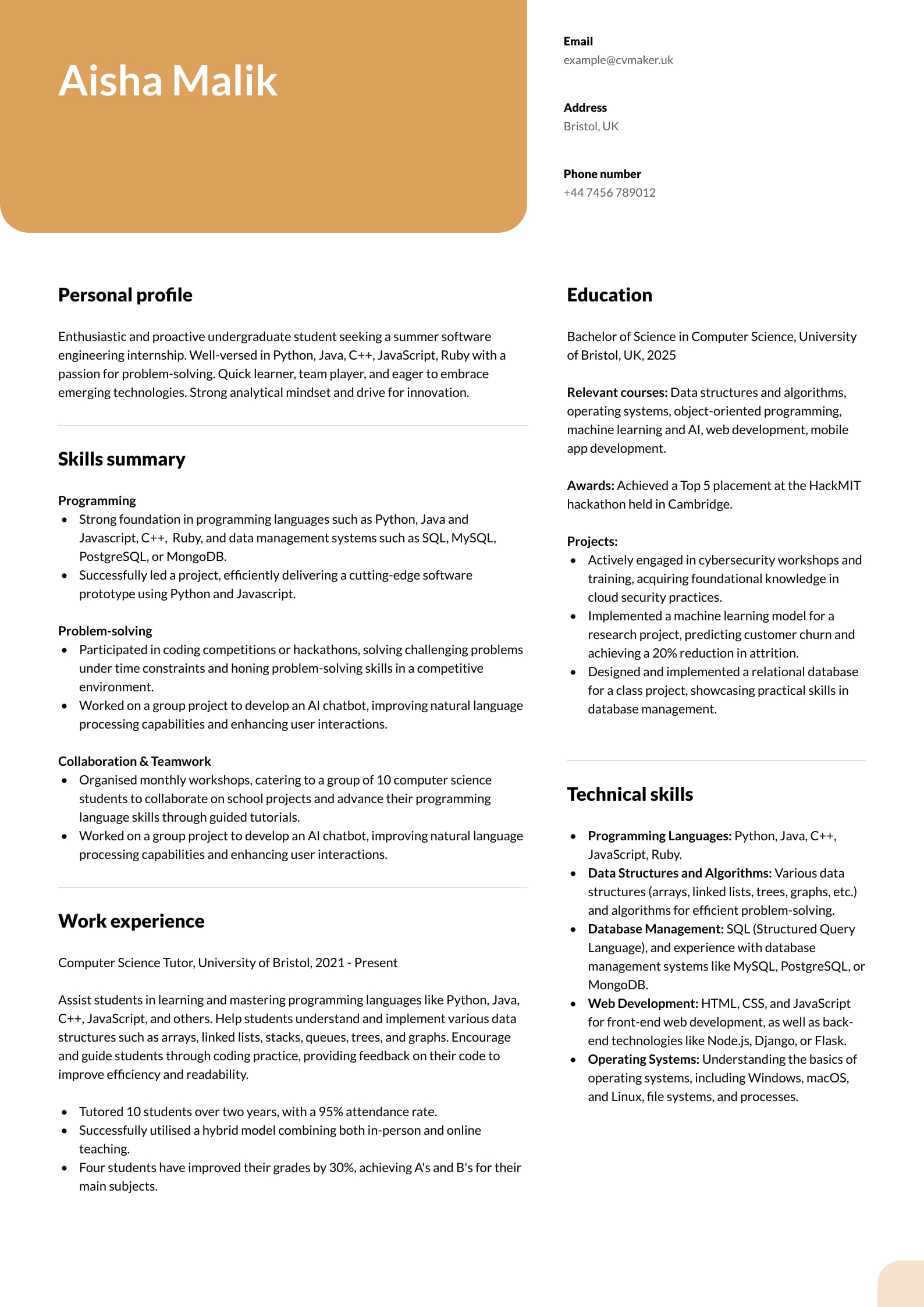
Engineering graduate CV example
) Download this engineer CV example free in PDF.
Download this engineer CV example free in PDF.
How to optimise your graduate CV for applicant tracking systems
When you apply for a graduate role, your CV usually goes through an applicant tracking system (ATS) before a human manager reads it. Research shows that up to 80% of mid-to-large UK employers use this software to scan and filter job applications. If your CV is not formatted correctly, the system might reject it automatically.
Creating an ATS-friendly CV is a straightforward process. You simply need to present your information in a way that the software can easily understand. Avoid using fancy templates with multiple columns, text boxes, or graphics. These elements can scramble the text and confuse the scanning software. Instead:
Stick to a standard, single-column layout.
Read the job description carefully
Identify the main skills the employer wants.
Include these exact keywords naturally within your work experience bullets and personal profile.
Save your CV as a plain Word document or a PDF with selectable text.
1. Keep your layout simple
Avoid using fancy templates with multiple columns or complex designs. ATS software reads documents from left to right and top to bottom. A standard, single-column layout ensures the system reads your education and experience in the correct order.
2. Remove graphics and text boxes
Logos, custom icons, and text boxes can easily confuse scanning software. The system often skips over information placed inside a graphic or a box. Stick to plain text for your section headings and contact details so nothing gets lost or scrambled.
3. Embed keywords naturally
Read the job description carefully and identify the main skills the employer wants. Include these exact keywords naturally within your work experience bullets and personal profile. The system looks for these terms to measure how well you match the role. Make sure the keywords in your CV fit logically into your sentences rather than just listing them randomly.
4. Choose the right file format
Always save your CV as a PDF with selectable text. If you use a PDF, try to highlight a sentence with your cursor. If you can highlight the text, the ATS can read it.
Pro tip
There’s no need to include your date of birth on a graduate CV. In the UK, employers focus on your skills and experience, not your age. Leaving it off helps prevent any unconscious bias and ensures you are judged solely on your qualifications and details that show you’re the right person for the job.
Common graduate CV mistakes to avoid
Many early rejections happen because of preventable errors. Being aware of these common pitfalls will give you a significant advantage over other candidates.
The most frequent mistake is sending a generic CV. Using a one-size-fits-all document for every application usually results in a quick rejection. Recruiters spend only a few seconds scanning a CV, and if they do not see a clear fit for the specific role, they will move on.
Another major issue is writing duty-only bullet points. Simply listing your responsibilities does not tell an employer how well you performed. Automated ranking algorithms also penalise statements that lack measurable outcomes.
Finally, be careful with generative AI tools. While they can help you brainstorm, relying heavily on them often results in formulaic phrasing and inflated claims. Always personalise your content and ensure it reflects your genuine voice and experience.

Must-have CV sections
Personal profile
Skills section
Work experience
Education
Learn more about how to write a good CV.
We recommend creating a master CV to store all your information and then creating a new CV when applying for a specific job. See our article on the CV Writing Process: Master vs Job-Specific CV for more details.
How to write a personal profile for a graduate CV?
A personal profile or personal statement best describes your personality, what you want to achieve, and how your experience can contribute to the company's growth. In four to six lines, briefly demonstrate your strengths, key skills, and qualifications relevant to the particular position you're applying for. Remember to incorporate soft skills in this section and leave any technical or hard skills for a separate section called 'Skills'.
See our related article on the top soft skills for a CV to learn more.
)
Additionally, mention your job target and career goals. Ensure you highlight soft skills such as pragmatic, attention to detail, and problem-solving in your personal profile. Create a separate section to expand on your hard skills, languages, or technical proficiencies.
For more information, refer to the article on how to write a personal profile on a CV.
Data Analyst Graduate CV Personal Profile Example
Result-driven Data Analyst graduate with strong knowledge of JavaScript, Python, Scala, SQL, and R. Knowledgable in machine learning and statistical tools. Adept at converting complex data into clean and easily understandable results. Demonstrated excellent communication and data visualisation skills.
See our data analyst CV example for more information.
Writer Graduate CV Personal Profile Example
Detail-orientated and creative English graduate, passionate about writing and technology. Strong editing skills gained through university courses, PR and communication assistance roles at student societies, and a part-time job in a bookshop. Independent yet outgoing technical writer with a strong work ethic and problem-solving skills.
Refer to our writer CV personal profile example to learn more.
Accounting Graduate CV Personal Profile Example
Attentive and enthusiastic graduate specialising in accounting and finance. Trained in governmental accounting procedures, financial statement preparation, budget analysis, and tax/audit policies. Experienced in QuickBooks, Odo, and custom accounting software.
How to add skills to a graduate CV?
When adding skills to your CV, ensure they are relevant to your job target. Place soft skills in the personal profile and hard skills under a separate section called 'Skills'. Be prepared to elaborate on these skills in your work experience entries, additional information and during interviews.
For STEM graduates, such as those in data analytics or engineering, the focus should be on technical proficiencies. Ensure you prominently list specific programming languages like Python or SQL, and mention the software you used during your studies. However, do not forget to include soft skills like teamwork and communication, as employers value well-rounded candidates.
Humanities graduates often have the opposite challenge. You might have excellent communication and critical thinking skills, but you need to anchor these to hard evidence. Highlight specific research projects, presentations, or data analysis you conducted during your degree.
For creative fields like marketing or graphic design, your CV should link directly to your portfolio. Start-ups and creative agencies often favour project-based screening. Including a link to your Behance, GitHub, or a personal website can significantly increase your interview chances.
| Soft skills | Hard skills |
|---|---|
| Communication | Data Analysis |
| Creativity | Project Management |
| Problem-solving | Machine learning |
| Attentive | Social Media Management |
| Time Management | Graphic Design |
| Organisation | Customer Service |
| Teamwork | Sales |
How to write impactful work experience entries with the STAR-O framework
To make your experience stand out, you need to show the impact of your work. The STAR-O model is a highly effective way to structure your bullet points and content. It stands for Situation, Task, Action, Result, and Outcome.
This framework helps you move away from simply listing duties. Instead, it proves your value by highlighting what you achieved and why it mattered to the organisation. Keep your bullet points to one or two lines, starting with a strong action verb.
Here is an example of a STAR-O bullet point:
"Automated weekly sales reporting for a 12-person retail team, reducing data preparation time by 40% and enabling management to reallocate 10 hours a month to customer engagement."
Notice how this includes specific metrics and a clear benefit. You can apply this structure to part-time jobs, university projects, or volunteer work.
Work experience is the core of any professional CV, although you may not have much work experience as a recent graduate. The key is to:
Keep it brief and clear, ideally no more than five to six lines per job.
Start sentences with action verbs such as 'Developed' or 'Streamlined' to describe your duties and achievements.
Include relevant experiences or transferrable skills gained from university projects or side jobs.

What should each work experience entry include?
Job title of current or previous role
Organisation name and location
Dates of employment (month/year)
A concise paragraph detailing your duties
Followed by 2–3 bullet points that highlight your key achievements or measurable impact.
Learn more about the work experience section in a CV.
Work experience examples for graduates:
Computer Science Graduate Apprentice, Codesmiths Solutions, 2020-2022
Worked with senior software developers and UX designers to develop and maintain a new e-commerce website for a fashion retailer. Learned and applied various programming languages, including Java, JavaScript, and Python. Designed and implemented database systems for storing and managing e-commerce information. Tested and debugged code to ensure the platforms were bug-free and secure.
Developed a new web application for e-commerce websites that increased user engagement by 20%.
Optimised a database query that improved application performance by 30%.
Identified and resolved a critical bug in the e-commerce websites that prevented the applications from crashing during Black Friday sales.
Part-time Junior Finance Analyst, Market Analytics Consultant, UK, 2015-2018
Assisted senior financial analysts in researching and analysing financial information for potential investment opportunities, such as analysing stock market trends and company financial statements. Assisted in creating financial models and reports to assess the profitability and risk of potential investments. Compiled and analysed market information to identify trends and opportunities for investment.
Successfully assisted in identifying a new investment opportunity in the renewable energy sector that generated a profit of 15% for the company.
Contributed to the creation of a financial model that accurately predicted the company's share price, which helped the company make informed investment decisions.
Compiled and analysed market information to make strategic investment decisions, such as diversifying the company's portfolio into new markets.
Engineering Graduate Intern, Synergy Engineering Consultants, January 2023- September 2023
Assisted senior engineers in designing and developing new projects (projects), including the design of a new school building. Conducted research and testing on new building materials and technologies.Created prototypes and test models of new designs (designs) using computer-aided design (CAD) software. Prepared technical reports and presentations for project reviews and to clients.
Successfully designed and prototyped a new lightweight structural component for the school building (project), which reduced the weight of the building by 10%.
Developed a new procedure for testing the fire resistance of new building materials.
Prepared a comprehensive technical report that was used to secure a new contract for the company to design and build a new hospital.
Internships are perhaps the best substitute for your work experience because they clearly show how you applied your skills learned. Additionally, skills gained from an internship make you more valuable as an employee.
How to write a graduate CV with no professional experience
It is completely normal to graduate without formal industry experience. Employers understand this, but they still want to see evidence of your work ethic, adaptability, and transferable skills.
You can fill the experience gap by highlighting other activities. University projects are a great place to start. Treat major group assignments or your dissertation like a job. Detail the scope of the project, your specific role, and the final grade or outcome.
Volunteering and student societies also provide valuable material. If you managed the budget for a university club or organised a charity event, you demonstrated leadership, organisation, and financial responsibility.
Do not discount part-time jobs in retail or hospitality. These roles teach you customer service, time management, and conflict resolution. Use the STAR-O framework to describe a time you handled a difficult customer or trained a new staff member.
How to add education to a graduate CV
The education section is a must-have for your CV, where you can elaborate on your qualifications, degrees, and additional courses you have undertaken. Remember, while some recruiters don’t require you to possess a specific degree, others do. Carefully review the job requirements to see if you’re eligible for your desired job position.
Start by writing a short description of your degree and then use bullet points to list your relevant coursework or other achievements like projects.
Pro tip
If you’re a recent graduate, it’s often best to place your education section at the top of your CV. This highlights your most relevant academic achievements and makes it easy for employers to see your qualifications right away.
Examples of education:
UK GCSEs
[n] GCSEs (including Mathematics and English)
[School Name], [School Location], [Years Attended]
Hillside High School, Manchester, UK, 2014 - 2016
10 GCSEs in grades A–C, including Mathematics and English
A Levels
[A Level] in [Subject 1], [Subject 2], [Subject 3]
[School Name], [School Location], [Years Attended]
Biology (A) Geography (B) Economics (C)
Manchester College, Manchester, UK, 2016 - 2018
BTEC
BTEC [Level] [Qualification] in [Subject Name]
[Institution Name], [School Location], [Years Attended]
BTEC Level 3 Extended Diploma in Information Technology
Hillside High School, Manchester, UK, 2014-2016
NVQ
NVQ [Level] in [Subject Name]
[Institution Name], [Location], [Years Attended]
NVQ Level 2 in Hospitality and Catering
Manchester College, Manchester, UK, 2014-2016
Diploma
[Diploma name] and [Level]
[Institution Name], [Location], [Years Attended]
Level 2 Diploma in Early Childhood Education, Manchester College, Manchester, 2016 – 2017
Highlighting projects on your CV provides recruiters with examples of your transferable skills applied in a non-academic setting. Adding them to your CV illustrates your ability to commit time, lead, initiate, or manage projects over a long period.
What courses and certificates to choose for a graduate CV?
Courses and certificates are essential in showcasing your potential, especially when you're at the early stages of your career and may lack work experience. This section adds depth by complementing your hard skills and work experience sections. Remember, brevity is key – aim for one to two lines per course to impress your recruiters.
If you aim for a specific industry, consider enrolling in specific courses to improve your knowledge and skills. This highlights your commitment to continuous learning and distinguishes you from other candidates.
Examples of courses for graduates:
Social Media Management, Hootsuite Academy, 2022
Graphic Design Basics, Adobe Creative Cloud, 2021
Entrepreneurship Essentials, Coursera, 2020
Public Speaking Mastery, Toastmasters International, 2019
Customer Service Fundamentals, LinkedIn Learning, 2018
Business Ethics and Compliance, FutureLearn, 2017
To discover suitable courses, explore diverse graduate schemes with the National Careers Service or check out a graduate job finder on Prospects.
If you’re looking for accredited online courses as a fresh graduate, consider using one of the course providers below.
To learn more, refer to our blog article on how to list courses and certificates on a CV.
Tips for international graduates in the UK
International students face additional hurdles, primarily around employer concerns regarding visa sponsorship. Some employers hold misconceptions about the cost and complexity of the Skilled Worker visa process.
To navigate this, focus on being as clear and straightforward as possible. If you hold a Graduate Route visa that gives you the right to work in the UK without sponsorship for two years, state this clearly in your personal profile. This immediately removes the employer's initial hesitation.
Additionally, use your international background as a strength. Highlight your adaptability, cross-cultural communication skills, and any additional languages you speak. These are highly sought-after traits in global businesses.
CV checklist: No experience edition
Writing a strong CV is an iterative process. As you send out applications, pay attention to the responses you receive. Track your progress and adapt your keyword strategy if you are not getting past the initial screening stages.
) Download this CV checklist: No experience edition free in PDF.
Download this CV checklist: No experience edition free in PDF.
Key takeaways
Ultimately, a successful CV hinges on a strategic approach, focusing on specific roles while showcasing relevant work experiences and transferable skills. Applying what you've learned in this guide gives more insight needed to navigate this ever-changing job market and attain your career goals!
Do
Choose the right CV format
Use clear and concise language
Proofread carefully
Tailor to the specific job
Keep it neat yet ATS-friendly
Don't
Use colloquial terms or slang
Include outdated information.
Add data or facts you cannot back up
Neglect your professional network
Overcomplicate design
Next steps?
Use our AI CV maker tool to create a CV that will get you hired in no time . To help you achieve your career goals, our team has designed ATS-friendly and professional CV templates and cover letter templates for you to draw inspiration. A professionally crafted CV tailored to a specific job description will speak directly to hiring managers, bringing your ideal graduate role within reach.
FAQ
What should a graduate CV look like?
A strong graduate CV is tailored to the specific role, emphasising relevant skills and motivation. Keep it brief and preferably no more than 2 pages long. Highlight relevant work experiences, such as internships or apprenticeships, and showcase transferable skills gained from your side jobs, volunteer roles, or university projects. Clearly outline academic and work-related skills to demonstrate your potential to achieve high results within an organisation.
What is the best font for a graduate CV?
Use a consistent professional font between the sizes 11 and 12. Most importantly, ensure it is easy to read, as recruiters, on average, only spend a few seconds assessing your application. See our list of the top five fonts below:
Top 5 CV fonts for a graduate CV:
Calibri
Cambria
Georgia
Helvetica
Arial
For more information, refer to our related blog article on choosing the best for your CV.
How to format your graduate CV?
Opt for the widely recognised reverse-chronological format. Submit your CV in PDF or Doc to make sure it is compatible across devices while maintaining a clear format. Minimise white space, exclude irrelevant sections and double-check details for consistency.
If you have little to no experience, it's best to use a skills-based format, allowing you to elaborate on your transferrable skills gained from projects, side activities, or work experience.
How long should my graduate CV be?
Your CV must be 1-2 pages long. Ideally, it is better to keep everything on one page. Try to avoid using lengthy and vague words. Note that two or more pages long CVs are not recommended unless you have many years of relevant experience or are applying for a job in academia or STEM industries.
Refer to the blog article on how long should a CV be for more information.
Do your university grades matter to employers in UK?
In specific roles, especially those requiring in-depth knowledge, grades do matter - consider jobs asking for a 2:1 or a first-class degree. Yet, it's crucial to recognise that practical experience, such as internships or group projects, often holds more sway on your CV. While employers may consider your university's reputation and final grades, highlighting practical skills and specific experiences, like successfully managing a team project or applying coursework to real-world scenarios, can truly distinguish you in a competitive job market.