
How to write a teacher cover letter: templates, examples, and tips
A strong teacher CV outlines your qualifications, but your cover letter is where you show how you teach, why you teach, and what you bring to a school community. A well-written teacher cover letter connects your classroom experience, subject knowledge, and teaching philosophy directly to the role.
This guide explains how to write an effective teacher cover letter for UK schools, provides practical advice and gives examples that can be adapted for various teaching roles.
In this article, we cover:
How to structure and format a professional teacher cover letter
What to include in a cover letter for a teacher job (with and without experience)
Teacher cover letter examples by subject and career stage.

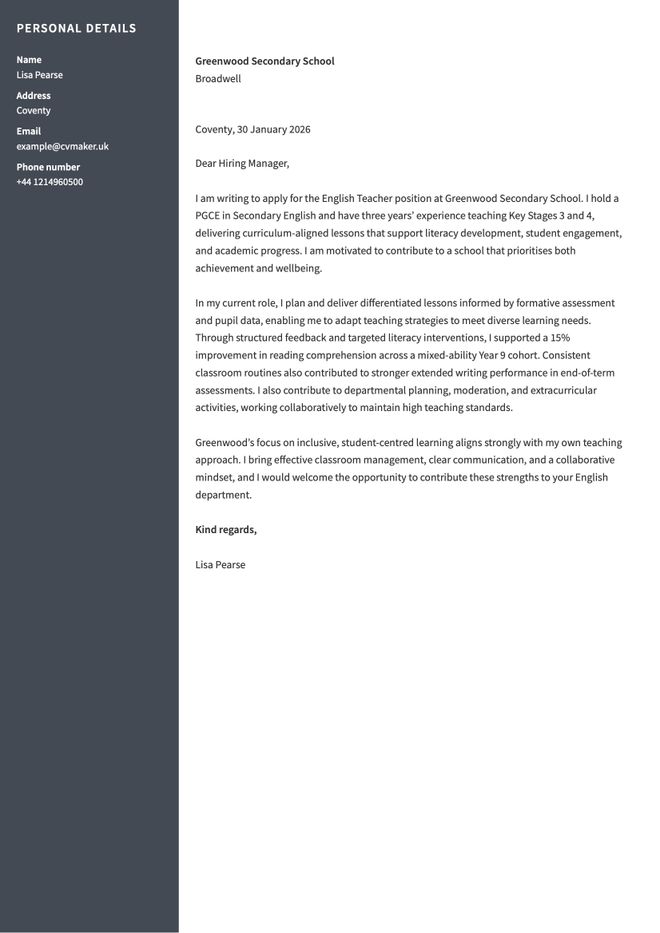
Teacher cover letter example (with experience)
) Download the teacher cover letter example in PDF
Download the teacher cover letter example in PDF
Why does this cover letter template work?
This teacher cover letter template uses the Harvard layout, presenting the candidate’s experience in a clear, professional, and easy-to-read format that aligns with UK education standards
The structure guides hiring managers through key teaching experience, classroom approach, and alignment with school values
Consistent fonts, colours, spacing, and layout reflect the attention to detail expected in education.
This template is clear and ATS- friendly for a job application, which works across various subjects and can be applied to cover letters for English teachers, special needs teachers, or physical education teachers.
Learn more about the ideal length for a cover letter.
Pro Tip
Don’t forget to add your contact details to the header of your cover letter. Include your name, address and telephone number.
How to format a cover letter for teaching jobs
A professional cover letter should be concise, formal, and tailored to the specific school and role. Clear formatting helps recruiters quickly identify your suitability for the position. Your cover letter should always be adapted to the specific job description.
Include the following sections:
Opening paragraph: state the teaching role you’re applying for and why the school appeals to you
Teaching experience and approach: highlight your subject specialism, key stages taught, and the impact on your classroom
School alignment: show how your values, teaching style, or experience support the school’s ethos or priorities
Closing paragraph: reinforce your interest and invite further discussion.

Must-have cover letter sections
Personal details: Include your full name, contact information, and location.
Introduction: Start with a greeting, then provide a concise yet compelling introduction.
Body: Highlight pertinent expertise and abilities, incorporating noteworthy achievements if applicable.
Conclusion: Summarise everything into a brief paragraph, followed by a professional sign-off.
Learn more about how to write a good cover letter.
Extra guidance to get started:
Explore our other cover letter templates to suit your career needs in the education sector. Read our teacher CV guide and blogs below for ideas on what information to include, and align it with your cover letter.
How to write a personal profile
Skills on a CV
How to list education
Work experience for a CV.
How to make your teacher cover letter ATS-friendly
More schools, academy trusts, and education HR teams in the UK are adopting applicant tracking systems (ATS). This means writing an ATS-friendly cover letter and pairing it with a modern CV for a teaching job is essential.
These systems help recruiters manage high volumes of applications by scanning each teacher's cover letter for relevant keywords, clear structure, and evidence to see if candidates like you meet the job requirements!
5 tips for tailoring your cover letter to teaching jobs
Mirror the job description: use terminology found in the advert, such as key stages, curriculum delivery, behaviour management, or safeguarding
Use clear job titles: reference roles like Primary Teacher, Secondary English Teacher, or Early Careers Teacher (ECT) to ensure clarity.
Focus on evidence, not claims: replace generic statements with brief examples of student progress, lesson planning, or academic support
Keep formatting simple: avoid tables, graphics, or unusual fonts that (ATS) software may struggle to read
Balance keywords with narrative: combine required skills with short, evidence-based stories that show how you apply them in practice.
Quick tip
Don’t repeat the job description word for word. In a strong teacher cover letter, briefly show how you apply the skills listed.
How to write a good cover letter introduction for teaching roles
A good cover letter introduction opens with clarity, confidence, and relevance. For teaching jobs, it should quickly show alignment with the school, your teaching focus, career goals, and highlight the unique value you bring to the classroom.
If you’re writing a cover letter for a teaching position in a specific subject, the opening paragraph should clearly answer one question for the recruiter: ‘why and how are you the right teacher for this role?’
Tips for writing an effective teacher cover letter introduction
When drafting the opening of your teacher cover letter, aim to:
Clearly state the role you’re applying for (e.g. primary teacher, secondary specialist)
Reference the school or trust to show genuine interest
Highlight one key strength or area of expertise (subject knowledge, SEN experience, classroom management)
Keep it concise. 2 to 3 sentences is ideal for a strong first impression.
Teacher cover letter introduction examples
Below are tailored opening examples that can be adapted for different teaching specialisms.
Cover letter for PE Teacher
“I am writing to apply for the Physical Education Teacher position at Ridgeway Secondary School. With experience delivering engaging PE lessons across Key Stages 3 and 4, I am committed to promoting physical wellbeing, teamwork, and inclusive participation while supporting students of all abilities.”
Cover letter for Special Needs Teacher
“I am applying for the Special Educational Needs Teacher role at Willow Grove School, bringing experience supporting pupils with a wide range of learning and behavioural needs. My teaching approach focuses on structured support, inclusive learning strategies, and close collaboration with SENCOs and families to help every student succeed.”
These examples can be adapted for cover letters in other educational subjects such as music, design, art, mathematics, foreign languages and more.
For more insights, read Is a cover letter necessary for your job application in 2026?
Main elements of a teacher cover letter
The body of your teacher cover letter UK application is where you demonstrate suitability for the role. This section should link your experience directly to the school’s needs and expectations.
Tips for a good teacher cover letter body
Show, don’t tell: use short, evidence-based examples instead of broad and vague statements to prove your impact
Highlight transferable skills: if you’re changing roles or writing a cover letter for a teacher without experience, focus on soft skills like communication, organisation, adaptability, and creativity
Tailor content to the role: align your experience with the subject or setting, whether it’s a cover letter for an Art teacher, English teacher or Special Needs Teacher, etc.
Discover our list of the top skills employers look for to guide your next application.
Teacher cover letter body paragraph examples
Below are short examples showing how to present impact clearly and concisely.
Cover letter for Maths Teacher
“In my current role, I deliver engaging maths lessons across Key Stages 3 and 4, using differentiated strategies to support mixed-ability classes. I regularly track progress using formative assessments, contributing to improved attainment and confidence in numeracy.”
Cover letter for English Teacher
“I have experience planning and delivering English lessons that develop literacy, critical thinking, and communication skills. By using structured feedback and inclusive teaching strategies, I have supported students to improve written outcomes and exam performance.”
Cover letter for NQT (Newly Qualified Teacher)
“As an NQT, I bring strong lesson planning skills, enthusiasm for learning, and a reflective teaching approach. My training placements strengthened my classroom management, safeguarding awareness, and ability to adapt lessons to meet diverse learning needs.”
How to end a cover letter for teaching jobs
The conclusion of your teacher cover letter is your final opportunity to reinforce enthusiasm and professionalism. A strong cover letter ending should confidently summarise your value as an educator, reaffirm your passions and interest in the role, and encourage recruiters to invite further discussion in a job interview!
Need a boost in confidence or applying for your first job? Read our top tips on how to answer a recruiter’s favourite interview question: ‘tell me about yourself’.
Cover letter conclusion tips
Highlight enthusiasm for teaching and classroom practice
Reference training placements or recent qualifications
Emphasise willingness to grow within the school community.
Pro Tip
If you’re writing a cover letter for an NQT or teaching assistant, highlight relevant certificates or volunteer work with students to stand out.
Teacher cover letter conclusion examples
Maths Teacher
"Thank you for considering my application. I am enthusiastic about the opportunity to contribute my subject knowledge, structured teaching approach, and commitment to raising attainment in mathematics. I would welcome the opportunity to discuss how I can support your students’ academic progress.”
English Teacher
“I would be delighted to join your English department and contribute to a culture of literacy, creativity, and critical thinking. Thank you for reviewing my application. I look forward to the opportunity to discuss my suitability for the role.”
Teacher cover letter example without experience
“Thank you for taking the time to consider my application. I am eager to begin my teaching career in a supportive school environment where I can continue developing my skills while making a positive contribution to pupil learning.”
Teacher cover letter sample with no experience
This teacher cover letter sample demonstrates how to conclude your application confidently by focusing on potential, training, and alignment with the school’s values. If you’re a newly qualified teacher or entering the workplace, you can make a strong impression despite limited experience. Consider writing a skills-based CV to showcase your qualities to employers instead! Even with little to no experience, you can write a job-winning cover letter.
Refer to our graduate and PhD CV example guides if you’re looking for a new teaching role and changing careers for the latest advice.
Teacher cover letter sample with no experience (UK)
) [Download this teacher cover letter with no experience]
[Download this teacher cover letter with no experience]
All of these examples can also be adapted for a covering message for teacher job applications or shorter online forms. Discover other cover letter examples tailored to other in-demand UK jobs for inspiration.
Teacher cover letter essentials
Before submitting your application, make sure that your teacher's cover letter includes the following essentials:
A tailored introduction aligned with the school and role
Evidence-based examples of teaching practice or transferable skills
Clear structure with professional tone and formatting
A confident conclusion reinforcing interest and suitability.
Consult our career blog on how to improve your CV for more ideas on strengthening your cover letter for a teacher job.
Next steps?
With your cover letter ready, polish up the final touches by adding professional references and practising competency-based interview questions for the final stage. If you’re an international student, learn how to list language skills and explore the latest job opportunities. Get prepared by staying organised with a job application tracker and learn more about employee benefits for your ideal job in teaching.
FAQs
How long should a teacher’s cover letter be?
A teacher's cover letter should be no longer than one page, typically 3–5 concise paragraphs. Read our guide on CV length for more tips on improving your overall application.
What should a teacher's cover letter include?
It should include a tailored introduction, academic teaching experience or transferable skills, alignment with the school’s ethos, and a confident conclusion. Read how to create the perfect cover letter structure.
Can I apply for a teaching job if I am not from the UK?
Yes, but ensure your qualifications are recognised in the UK, your terminology matches the UK education system, and visa requirements are clearly addressed. Employment gaps should also be explained where relevant. Learn more with .
How can I make my cover letter stand out for a teaching job?
Focus on tailoring it to the school, use short evidence-based examples, and clearly show how your teaching approach supports student outcomes. Highlight your professional strengths and pair them with a well-written CV for teaching.
Do I need a new cover letter for each teaching job application?
Yes. While the structure can stay the same, each cover letter should be adapted to the specific school, role, and job description to maximise impact. For additional guidance, our teaching assistant CV example and teaching assistant cover letter example demonstrate how to structure a strong, school-ready application.