
How to Write a UK Driver CV: Example and Writing Guide
This guide covers everything you need to write a strong driver CV, whether you're applying for an HGV, delivery, bus, lorry, or train driver role. You'll find a professional driver CV example, applicant tracking system (ATS)-friendly CV templates and formatting tips, role-specific personal profile samples, and practical writing tips for each section.
Demand for qualified HGV drivers remains strong across the North West, Yorkshire, and the Midlands – make sure your CV reflects the qualifications and licences employers check first.

Driver CV example
)
Download this driver CV sample in PDF
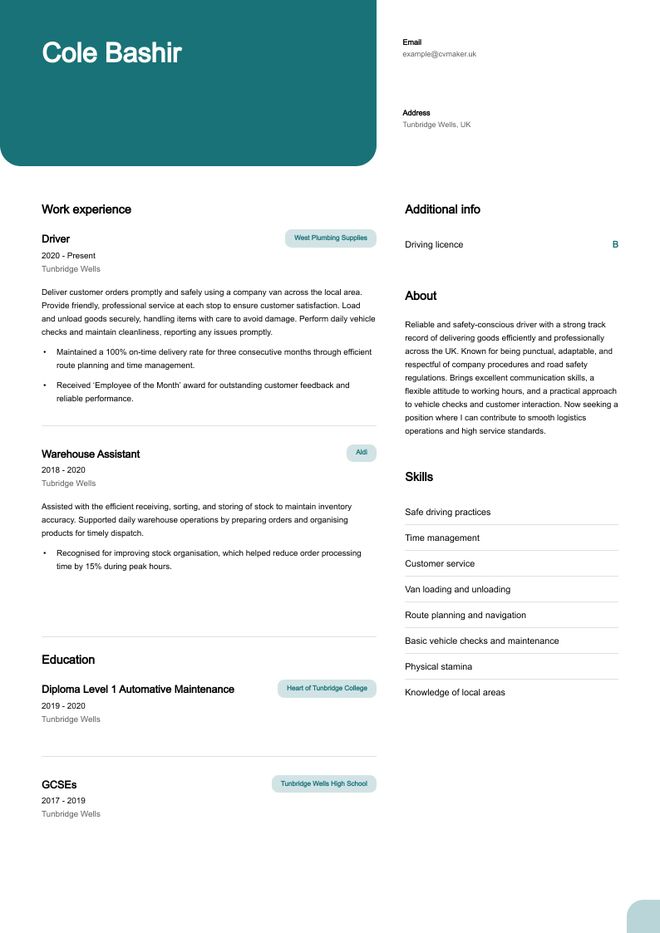
In this example of a CV for a driver, Cole presents his five years of experience and skills as a vehicle operator. He demonstrates proficiency in driving vehicles, adhering to regulations, and navigating diverse road networks. His professional Columbia CV template highlights expertise in vehicle maintenance and knowledge of UK road networks.
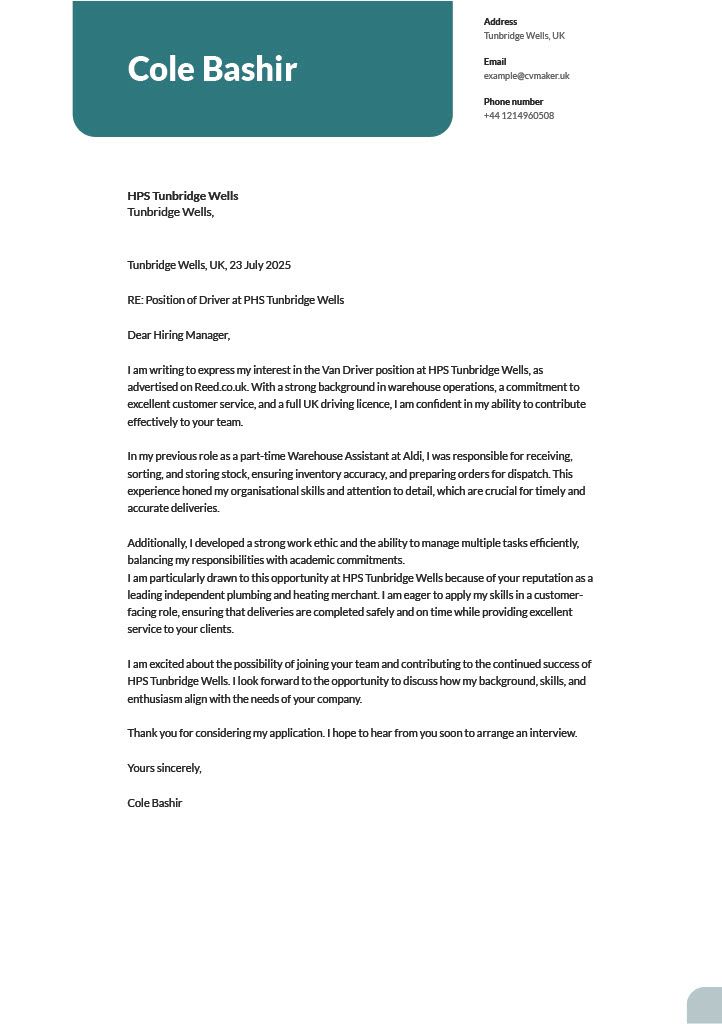
Check out our matching driver cover letter to help you streamline your application.
What to include in a driver CV?
If you want to write a CV for a driving job, you must provide a comprehensive overview of your qualifications and suitability for the role. Let’s explore each section, starting with the personal profile, and create a professional CV for your dream job.
Create a master CV with all your licences, qualifications, skills, and experience, then tailor it for each driving job by highlighting the most relevant information and using keywords from the job description.
If you have little to no work experience, we’ve included some useful tips to help get you started.
How to list licences and certifications on a driver CV
Employers scan for licences before almost anything else when hiring for driving roles, therefore it's important they can quickly find your driving licence information in your CV. Be sure to include the following:
Full UK driving licence with category (B, C1, C, C+E)
Whether the licence is clean
Driver Certificate of Professional Competence (CPC)—include expiry date; note that CPC is a legal requirement for HGV and passenger-carrying vehicle (PCV) roles
Digital tachograph card
Manual handling training (where applicable)
First aid certification (where applicable).
Key points to communicate clearly:
For HGV and PCV roles, the Certificate of Professional Competence (CPC) is a legal requirement—state this explicitly
For Category B delivery driver roles, a clean licence and any relevant additional training should be highlighted
List the category and date obtained for each licence
Example:
Licences and certifications
Full UK driving licence: Category C+E (clean), obtained 2017
Driver Certificate of Professional Competence (CPC): expires March 2027
Digital tachograph card: issued 2017
Emergency First Aid at Work: renewed 2024
How to write a personal profile on a driver CV
Your personal profile is crucial in summarising your relevant qualifications, experiences, and career objectives. It is an opportunity to make a strong initial impression on potential employers and highlight your unique strengths.
Pro tip
If you have little to no work experience, leverage your education, relevant internships or projects, and transferable skills in your personal profile.
Example of personal profile on a HGV driver CV
Experienced and reliable HGV driver with 8 years of experience and in-depth knowledge of UK road networks, regulations, and navigation skills. Proven track record of safe and efficient transportation of goods. Strong expertise in handling various cargo types and maintaining vehicle integrity. Committed to meeting tight schedules and prioritising safety. Seeking to utilise expertise and HGV driver certificate in a reputable organisation.
Example of personal profile on a delivery driver CV
Efficient delivery driver with 2 years of experience and excellent knowledge of local routes, traffic patterns, and efficient navigation strategies. Strong communication and customer service skills, ensuring positive interactions with clients. Proven ability to manage time effectively, meet tight delivery deadlines, and handle multiple deliveries. Committed to exceptional service, maintaining vehicle cleanliness, and secure transportation of goods.
Example of personal profile on a lorry driver CV
Dependable lorry driver with 8 years of expertise in safe and efficient transportation of goods. In-depth knowledge of UK road networks, regulations, and load handling. Skilled in operating specialised equipment and resolving challenges in diverse driving conditions. Committed to vehicle integrity and optimising routes for timely deliveries.
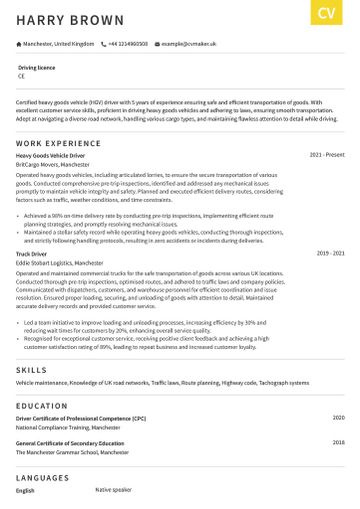
Learn more about how to write a HGV driver CV.
Example of personal profile on a bus driver CV
Professional and customer-orientated bus driver with 5 years of experience and committed to passenger safety and satisfaction. Excellent knowledge of local routes, traffic regulations, and efficient navigation. Strong communication and interpersonal skills, ensuring a pleasant and comfortable experience for passengers. Proven ability to handle diverse passenger needs, manage challenging situations, and adhere to schedules. Committed to maintaining a clean and well-maintained bus while providing reliable transportation service.
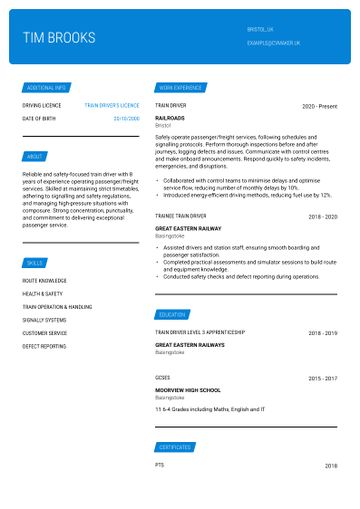
Example of personal profile on a train driver CV
Dedicated and safety-conscious train driver with 5 years of experience and expertise in efficient and reliable transportation. Extensive knowledge of rail networks, signalling systems, and safety procedures. Strong problem-solving skills and calmness in unexpected situations. Excellent communication and teamwork abilities for smooth coordination. Committed to providing punctual, comfortable, and safe journeys for passengers.
Learn more about how to write a train driver CV.
Example of personal profile on a supermarket delivery driver CV
Experienced supermarket delivery driver with a proven track record of timely and efficient service. With 3 years of experience and known for exceptional customer interaction. Committed to customer satisfaction and skilled in route navigation. Ready to contribute expertise to a dynamic delivery team.
Refer to our article on writing a compelling personal profile on your CV that aligns with your driving career goals.
What skills should I put on my CV for a driver job?
Operating a vehicle requires performing various domestic and commercial driving skills. Whether you're seeking a position to operate an HGV, use a forklift in a warehouse, or do deliveries, these jobs demand a multitude of skills as well as technical knowledge similar to a mechanic.
In a CV for drivers, it is essential to include a combination of hard and soft skills relevant to the specific driving role you are targeting. Separate a list of soft and hard skills to highlight specialisations, certifications, and technical expertise relevant to your driving role.
You should also consider the transferable skills you have gained from part-time work or apprenticeships that you can showcase for your next role and add to a skills-based CV if you have little to no work experience.
| Soft skills | Hard skills |
|---|---|
| Excellent communication | Valid and clean driving licence |
| Customer service | Knowledge of UK road regulations |
| Time management | Vehicle maintenance and inspection |
| Reliability and punctuality | GPS navigation and map reading |
| Problem-solving | Manoeuvring large vehicles |
| Adaptability | Operating specialised equipment |
| Attention to detail | Tachograph systems and record keeping |
| Independence | Route planning and optimisation |
| Collaboration | Hazard perception and defensive driving |
| Stress management | Cargo handling |
| Professionalism | Vehicle loading and securing |
| Work ethic | First aid and emergency response |
| Flexibility | Vehicle tracking and telematics systems |
| Safety-consciousness | Vehicle safety features and maintenance |
For more ideas on what to include in your skills section, read our article on what skills to put on a CV in the UK.
How to write work experience on a driver CV
In general, you should separate your duties from your accomplishments to showcase the practical application of your driving skills to further enforce your capabilities for your desired role. Take a look at the following work experience CV samples:
Bus driver CV work experience example:
Bus Driver, Griffin Transportation, London, UK, 2018 - Present
Safely operate buses to transport passengers to their destinations and adhere to traffic laws and company regulations. Conduct pre-trip inspections to ensure the bus works appropriately and report any issues or maintenance needs. Maintain accurate records of daily routes, passenger counts, and any incidents or accidents during the shift. Follow established routes and schedules, and adjust to accommodate traffic or unexpected delays.
Implemented a new routing system that reduced travel time by 10% and improved on-time performance by 15%.
Recognised for outstanding customer service and achieved a customer satisfaction rating of 95%.
Completed defensive driving training resulted in zero preventable accidents or incidents in the past two years.
HGV Operator CV work experience example
HGV Operator, Streamline Logistics, London, UK, 2018 - Present
Ensure the safe operation of heavy goods vehicles (HGVs) to transport goods and strictly follow traffic laws and company regulations. Conduct thorough pre-journey inspections and promptly report any issues or maintenance needs to maintain proper working conditions. Maintain accurate and detailed records of deliveries, mileage, and any incidents or accidents during transportation. Adapt to designated routes and schedules. Strictly adhere to safety procedures and protocols, and ensure the secure load and unloading of goods.
Streamlined delivery operations by implementing an innovative routing system, reducing delivery time by 20%.
Received recognition for maintaining an impeccable safety record and consistently meeting delivery deadlines.
Completed specialised training in advanced driving techniques, enhancing vehicle handling skills and reducing fuel consumption by 15%
For more details on including this section on your driving CV, refer to our article on how to write work experience.
How to list education on a driver CV
While educational qualifications for this type of role are typically not required, employers often look for a good standard of education, such as GCSEs. In addition to education, certificates and licences are crucial for certain positions, especially for operating a heavy goods vehicle. For all driving positions in the UK, you’ll need a Certificate of Professional Competence and licence.
When listing education on your CV, provide an overview of your educational background and highlight additional qualifications or training. Include any relevant courses and certificates related to driving or vehicles, such as a CPC course or a specialised driving course in auto repair, to demonstrate your driving skills and vehicular expertise.
In the UK, gaining educational qualifications for a driving role can be achieved through specific certifications and vocational courses. Obtaining the DVSA Approved Driving Instructor (ADI) qualification is essential for driving instructors.
Drivers of heavy goods vehicles (HGVs) or passenger-carrying vehicles (PCVs) must acquire the mandatory Certificate of Professional Competence (CPC) by completing 35 hours of periodic training every five years.
Vocational qualifications such as the Level 2 Certificate in Driving Goods Vehicles or Road Passenger Vehicle Driving can also enhance your driving qualifications.
Additional automotive engineering or mechanics courses can provide valuable vehicle maintenance and troubleshooting knowledge.
Combining educational qualifications with practical experience and licences strengthens your prospects in the competitive driving industry.
Education examples on a driver CV:
Example 1:
Level 2 Certificate in Driving Goods Vehicles, XYZ Driving School, London, UK, 2021.
Notable Courses: Hazard Perception, Emergency Manoeuvres, Safe Driving Practices, Adverse Weather Conditions, City Driving Skills.
Example 2:
Certificate of Professional Compliance (CPC) ABC Driving Academy, London, UK, 2019.
For more information on how to list education on your CV , refer to our helpful article in this section.
Dos and don'ts for a driver CV
Dos
List your licence category and whether it is clean
Include your CPC expiry date
Quantify achievements in your work experience
Tailor your personal profile to the specific role
Don'ts
Write "full driving licence" without specifying the category
Leave out certification dates – employers need to verify validity
Use vague phrases like "responsible for deliveries"
Submit the same CV for HGV, delivery, and bus driver roles
Key takeaways
Writing a professional driving CV requires a careful approach to thrive in the demanding and competitive transportation industry. You must emphasise your driving expertise, gain relevant driving licences and qualifications, and demonstrate flexibility and a willingness to comply with strict conduct. Using practical examples and insightful tips in this guide, you can effortlessly create a CV tailored to your career goals, whether entry-level or seeking to advance your career and improve your CV for higher-level driving roles.
Next steps?
If you're looking for a convenient CV template for a driving position, our CV Writing Service is here to assist you. Save time and effort using our pre-designed templates tailored to your job targets. Create an account and select a professional CV template aligned with your career aspirations. For additional support and inspiration in pursuing an entry-level driving role, browse our career blog, where you'll find valuable insights and tips to help you land and pass an interview for your dream role.
FAQ
How do I write a CV as a driver?
To write a modern CV, here are some top tips:
Highlight your relevant skills, experiences, and qualifications.
Include essential driving licences and certificates.
Use specific examples, actionable insights and quantify your achievements.
Tailor your job application with a complimentary cover letter that aligns with your career goals and the employer's requirements.
What are the different driver salaries in the UK?
Driver salaries in the UK vary depending on the type of vehicle, industry, location, and level of experience. Delivery drivers typically earn £25,000–£35,000 per year, while HGV (Class 1 and Class 2) drivers can earn £35,000–£50,000+, with higher salaries available for specialist or long-haul roles. Bus and coach drivers usually earn £28,000–£40,000, and train drivers are among the highest-paid, with salaries ranging from £35,000 during training to over £70,000 for experienced drivers. Many driving roles also offer overtime, shift allowances, and bonuses, which can significantly increase annual earnings.
What should I put on my CV for a driving job?
To write an effective driving CV, include essential sections such as your full driver's licence details, driving experience, and relevant certifications. Highlight your knowledge of vehicle maintenance, adherence to traffic laws, and familiarity with route planning software or GPS systems. Include any specialised driving experience or qualifications, such as HGV or passenger transportation. Lastly, emphasise soft and hard skills like road safety knowledge, excellent communication skills, and punctuality.
How to become a lorry driver in the UK?
To operate a lorry in the UK, you must meet specific requirements which are especially important if you are going through a career-change and do not have prior experience. Start by obtaining a full car driving licence. Then, pursue a professional driving qualification, such as a Large Goods Vehicle (LGV) or Heavy Goods Vehicle (HGV) licence. Complete the necessary training and pass the practical and theory tests specific to the licence you seek. Obtain a Driver Certificate of Professional Competence (CPC) by completing 35 hours of periodic training every five years.
What type of HGV licence should I get?
In the UK, the type of HGV licence you should obtain for your CV depends on the weight and type of vehicle you intend to drive. There are four categories: C1, C, C+E, and C1+E. Category C1 allows you to drive smaller rigid vehicles, while Category C covers larger ones. Category C+E is for articulated or drawbar vehicles, and Category C1+E is for larger vehicles towing a trailer. Choose the appropriate HGV licence category based on the vehicle you plan to operate and update your CV accordingly.
What is the training for drivers in the UK?
In the UK, training typically includes practical driving lessons and theoretical knowledge tests. You must complete training specific to the licence and job you’re targeting, such as LGV or HGV training. Training covers various aspects, including vehicle control, road safety, traffic laws, and hazard perception. Learn more about training as a driver in the UK.
How much does a driver Certificate of Professional Competence (CPC) training cost in the UK?
The cost of Driver CPC training in the UK varies depending on factors such as training provider, location, and the number of modules required. On average, the training cost ranges from £50 to £100 per module. The total cost may vary since 35 hours of periodic training are required every five years. Researching different training providers and comparing prices is advisable to find the best option that suits your budget and training needs. Find out how to get licensed and your driver CPC card.