
How to Write a Letter of Interest (with Template and Examples)
A letter of interest is a tool that allows jobseekers to proactively express their enthusiasm for a company, even when there are no advertised job openings. This type of letter can be a powerful way to uncover unlisted opportunities and communicate your career goals, leaving a strong impression on potential employers.
In this guide, we cover:
The difference between a letter of interest and a cover letter
How and when to use a letter of interest
Letter of interest sample for the UK
Job-specific expression of interest template
How to end a letter of interest to make a lasting impression.
Let CVMaker guide you through the cover letter writing process, offering a professional cover letter template to highlight your strengths.

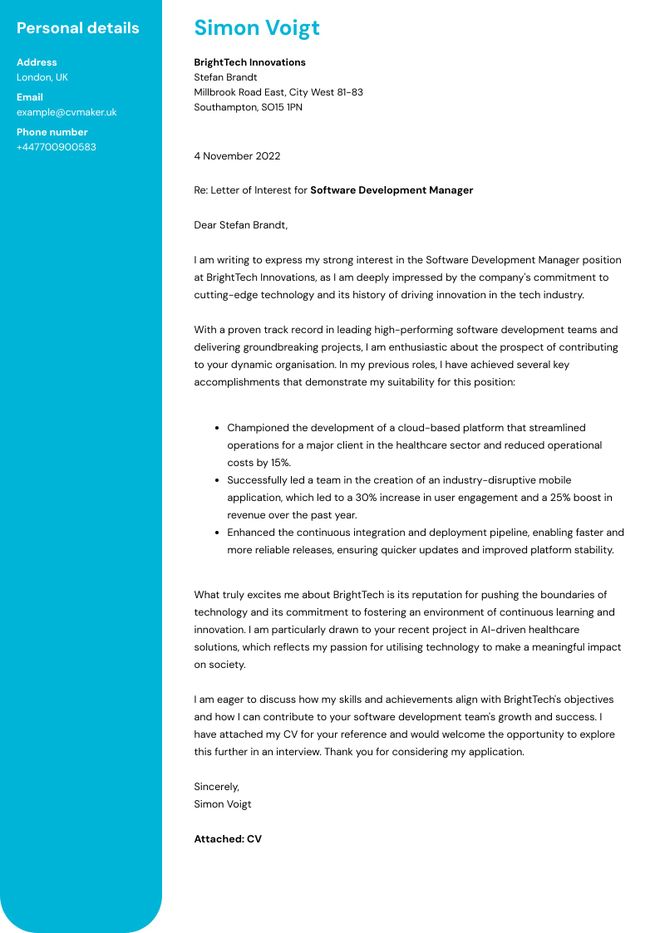
Letter of interest example
)
Download this free letter of interest example in PDF.
What’s the difference between a cover letter and a letter of interest?
A letter of interest and a cover letter are both important tools in a jobseeker's journey, but they serve different purposes and are used in distinct contexts.
Letter of interest
Also known as a prospecting letter, a letter of interest is sent to a company unsolicited, meaning there may not be any current job openings. The purpose is to express your interest in working for the company and to highlight your skills and experiences that make you a valuable potential hire.
Cover letter
A cover letter is sent in response to a specific job posting. It accompanies your CV and provides an opportunity to elaborate on your qualifications and experiences directly related to the job you're applying for. Learn more about how to write a good cover letter.
Who should use a letter of interest?
Career changers: Individuals looking to transition into a new field might use a letter of interest to introduce themselves to companies within their desired industry. For more tips, check out our guide on writing a cover letter for a career change.
Recent graduates: Fresh out of college, recent graduates or students often send letters of interest to potential employers to showcase their skills and eagerness to begin their professional journey.
Experienced professionals: Seasoned professionals seeking new challenges or wishing to work for a particular company may use a letter of interest to highlight their CV's extensive experience and specific skills.
Internal candidates: Current employees looking to transition into a different department or take on a new role within their organisation can use a letter of interest to express their ambitions and qualifications for internal job openings.
When to use a letter of interest?
Below are a few scenarios and examples of when to use a letter of interest.
1. Exploring hidden opportunities
John, a software developer, is interested in working for a leading tech company known for its innovation. By sending a letter of interest, he can introduce himself to the company's hiring managers and potentially uncover roles not yet publicly advertised.
Letter of interest example for a software developer
I am a software developer with experience in building scalable, user-focused applications. I have long admired your company’s commitment to innovation and would love the opportunity to contribute to future projects within your development team.
Complete writing guides: developer CV and developer cover letter.
2. Career advancement
Emma, a marketing coordinator at a large corporation, wants to move into a managerial position. Writing a letter of interest to the marketing team lead allows her to express her desire for career growth and highlight her achievements within the company.
Letter of interest example for a marketing manager
I am writing to express my interest in exploring potential managerial opportunities within the marketing department. Over the past three years as a marketing coordinator, I have led several successful campaigns and strengthened my skills in project management and team collaboration.
Complete writing guides: marketing CV and marketing cover letter.
3. Networking and building connections
Lisa, a recent graduate with a degree in finance, sends a letter of interest to various financial firms she admires. This helps her build professional relationships and stay on the radar of hiring managers for future opportunities.
Letter of interest example for a new graduate
I recently graduated with a degree in finance. I have followed your firm’s work in investment analysis and admire your commitment to client-focused financial solutions. I am writing to express my interest in connecting regarding any future opportunities within your organisation.
Complete writing guides: finance CV and finance cover letter.
4. Entering a new industry
Tom, an experienced sales professional, wants to pivot to a career in digital marketing. He sends a letter of interest to digital marketing agencies, emphasising his transferable skills and passion for the new field.
Letter of interest example for a career change
I am reaching out to express my interest in potential opportunities within your digital marketing team. With over seven years of experience in sales, I have developed strong communication, client-engagement, and data-driven decision-making skills. I am now eager to apply these strengths to a career in digital marketing.
Complete writing guide: digital marketing CV, sales CV, sales cover letter.
How to write a letter of interest
A letter of interest follows a similar format to the structure of a cover letter. Still, it focuses explicitly on conveying your enthusiasm for the company and potential opportunities that may not yet be available.
1. Research the company
Before you begin writing your letter of interest, take the time to research the company thoroughly. Explore its website, read news articles, and check out its social media profiles to understand its mission, values, and culture. This knowledge will allow you to tailor your letter to align with the company’s goals and ethos, demonstrating that you are genuinely interested in joining its team.
Letter of interest example
I am particularly drawn to EcoWear's commitment to sustainability and eco-friendly practices, which align perfectly with my passion for environmental stewardship. In my previous role at Seeds, I spearheaded several initiatives aimed at reducing carbon footprint and promoting sustainable practices. I am eager to bring my expertise and dedication to EcoWear’s and contribute to its mission of environmental responsibility.
If the company emphasises sustainability and eco-friendly practices, mention your passion for environmental issues and any related experience you have.
Complete writing guides: sustainability CV and sustainability cover letter.
2. Address the right person
Whenever possible, address your letter to a specific person rather than using a generic salutation like "To Whom It May Concern." Look for the name of the hiring manager, department head, or recruiter. This personal touch shows that you have made an effort to learn more about the company and the people who work there. For more insights, check out our guide on how to write a good cover letter.
Pro tip
If you have identified the hiring manager's name, instead of writing "Dear Hiring Manager," you might write "Dear Mr. Smith."
3. Introduce yourself
Start your letter of interest with a strong introduction that captures the reader’s attention. Mention how you found out about the job opening or the company, and briefly explain why you are excited about this opportunity. This helps establish a connection right from the beginning.
Letter of interest example
I am writing to express my interest in the Marketing Coordinator position at GreenEarth Solutions, which I discovered through your recent LinkedIn post. As a long-time admirer of your innovative approach to sustainable living, I am eager to contribute to your mission.

Letter of interest introduction
Keep it short and sweet
Add current date, location, and salutation
Introduce yourself and mention relevant background and expertise
4. Highlight relevant skills and experience
Clearly outline your CV skills, accomplishments, and experiences that would be beneficial to the company.
Use specific examples to demonstrate your value and how your background makes you a great fit for the role.
Avoid generic statements and focus on quantifiable achievements.
Letter of interest example
During my tenure at Creative Sparks, I successfully managed a marketing campaign that increased our online engagement by 30% within six months. My expertise in digital marketing and data analysis will be an asset to your team as you continue to expand your online presence.
)
For more tips, refer to our guide on the top skills employers are looking for.
5. Show enthusiasm and cultural fit
Explain why you are enthusiastic about the company and how you would fit into their culture. This shows that you are not only interested in the job but also in becoming a part of the company's community.
Letter of interest example
Your company’s dedication to innovative and eco-friendly products aligns perfectly with my personal values and professional goals. I am excited about the prospect of working in an environment that fosters creativity and sustainability. I would love the opportunity to discuss how my background, skills, and certifications align with the needs of your team.
6. Close with a call to action
End your letter of interest with a polite call to action. This could be a request for an informational interview, a meeting to discuss potential opportunities, or simply expressing your eagerness to further discuss how you can contribute to the company.
Letter of interest example
I would love the opportunity to discuss how my background, skills, and certifications align with the needs of your team. Please feel free to contact me at your earliest convenience to schedule an interview. Thank you for considering my application.
)
What to avoid including in a letter of interest
When you’re reaching out to a company, you want to come across as positive, professional, and genuinely interested. To keep your letter on the right track, here are a few dos and don'ts:
Keep it short and to the point
“I’m reaching out to express my interest in future opportunities within your team.”
Assume a role is open
“I look forward to starting the role soon.”
Show genuine interest
“I’ve been following your sustainability projects and would love to be involved.”
Be vague and generic
“Your company seems like a good place to work, and I would be thrilled to join the team."
Focus on your value
“I’d be happy to contribute my skills in customer support and administration.”
Discuss salary or perks
“I’m seeking a salary in the region of £40,000.”
Letter of interest examples
Here are several examples demonstrating how to structure and craft an effective letter of interest:
Letter of interest example for teachers
)
Download this free teaching letter of interest example in PDF.
Letter of interest example for internships
)
Download this free internship letter of interest example in PDF.
)
Letter of interest example for nursing roles
)
Download this free nursing letter of interest example in PDF.
Letter of interest example for architecture jobs
)
Download this free architecture letter of interest example in PDF.
Letter of interest example with no experience
)
Download this free letter of interest example for non-experienced professionals in PDF.
Letter of interest essentials
A letter of interest is used to express unsolicited interest in working for a company, while a cover letter is sent in response to a specific job posting.
Researching the company, addressing the right person, and highlighting your relevant skills and experience are crucial components of a strong letter of interest.
Demonstrating enthusiasm for the company and fitting into its culture can make your letter stand out.
Closing with a call to action can prompt further communication and opportunities.
Next steps?
Ready to create a modern CV and matching cover letter to increase your chances of landing your dream job? You can use our dedicated CV Writing Service to streamline the process and save time and effort. Additionally, visit our career blog for advice on how to prepare for a job interview, and how to answer common questions.
FAQs
How long should a letter of interest be?
A letter of interest should be concise, ideally no longer than one page. It should be long enough to convey your qualifications and enthusiasm, but brief enough to be quickly read.
For more insights, refer to our article on cover letter length.
What is the difference between a letter of interest and a letter of intent?
A letter of interest is used to express unsolicited interest in potential job opportunities, while a letter of intent is often used in specific situations, such as applying for graduate school or formalising agreements, to indicate a commitment to a particular course of action.
Do letters of interest work?
Yes, letters of interest can be effective, especially when they are well-written, personalised, and highlight relevant qualifications. They show initiative and can create opportunities where none previously existed.
For more tips, check out this article on why a cover letter is necessary.
Should I include my CV with a letter of interest?
Yes, it is advisable to include your CV with a letter of interest. This provides the employer with a comprehensive view of your qualifications and experiences.