
How to Write a Work Placement Cover Letter (Template & Examples)
A work placement cover letter introduces you to an employer and explains why you're applying for a placement opportunity. It highlights your motivation, relevant skills, education, and willingness to learn, even if you have little or no work experience.
This step-by-step guide covers everything you need to write a strong work placement cover letter – from structure and format to what to include at each stage. Whether you're a student or a graduate, you'll find practical tips, examples, and templates to help you put your best foot forward.

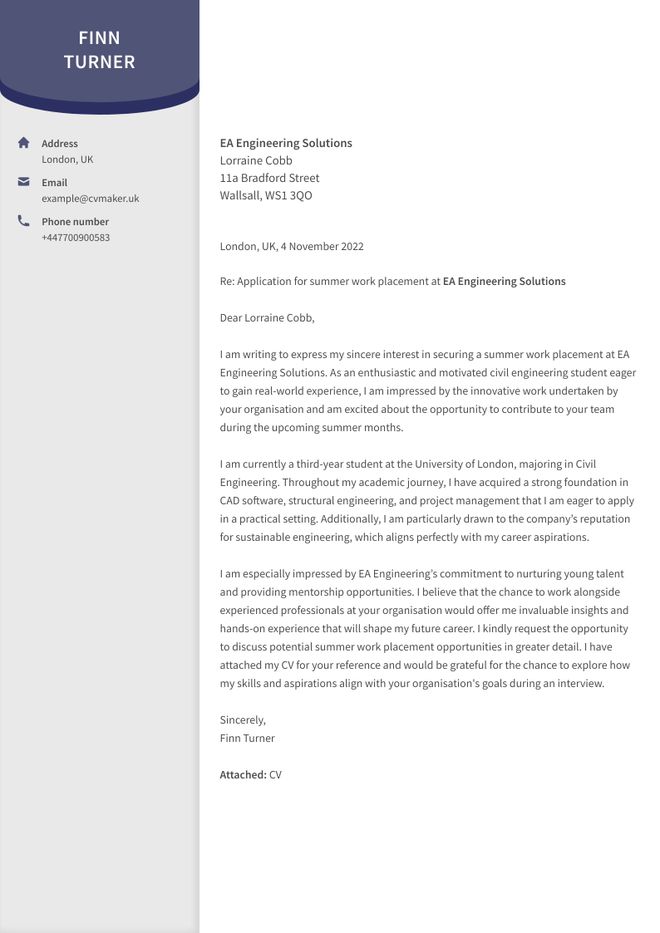
Work placement cover letter example
)
Download this work placement cover letter sample in PDF.
This cover letter example features Finn Turner, a civil engineering student applying for a summer work placement at EA Engineering Solutions. As evidenced by his strong educational background, he is a quick learner with a strong foundation in the field. This cover letter follows a professional format with easy-to-read language and good structure. It explicitly shows his contact details, position applied, and reasons for applying.
How to write a work placement cover letter with no experience
When applying for a work placement, you don't need previous work experience to make a strong impression. Instead, focus on your education, transferable skills, interests, and career goals. Explaining why you're interested in the placement, what you hope to learn, and how your studies or extracurricular activities have prepared you for the opportunity helps employers recognise your potential and enthusiasm.
Here are three practical tactics to strengthen your cover letter when experience is limited:
1. Lead with relevant coursework or academic projects
If you've completed a module, project, or assignment that mirrors the role's requirements, mention it. This shows you already have a foundation in the field, even without formal work experience.
Example
During my studies, I completed a marketing project where I worked with a team to develop a social media campaign for a local business. I conducted market research, helped create content, and presented our recommendations to the class. This project strengthened my communication, teamwork, and analytical skills, and inspired me to gain practical experience through a work placement.
2. Draw on extracurricular activities, volunteering, or part-time work
These demonstrate transferable skills, such as teamwork, communication, and time management, that are just as valuable to an employer as direct experience.
Example
Alongside my studies, I volunteered at a local charity shop, where I assisted customers, organised stock, and worked as part of a team to keep the shop running smoothly. This experience helped me develop strong communication, customer service, and time management skills, which I am eager to apply and build on during a work placement.
3. Show genuine company knowledge
Briefly explain why this specific organisation appeals to you. Referencing a recent project, company value, or area of work signals that your application is considered, not generic.
Example
I am particularly interested in completing my work placement with your organisation because of your commitment to sustainability and innovation. After reading about your recent community initiative and the opportunities you provide for students to learn from experienced professionals, I am excited by the chance to contribute while developing my own skills in a supportive environment.
If you're applying to an organisation that hasn't advertised a placement, a letter of interest is the right approach. Use it to outline how your qualifications align with the company's work and express your interest in being considered for future opportunities.
If you're targeting a summer placement, check the key details first: duration, salary, full-time or part-time, industry type, company culture, and job criteria. This will help you tailor your cover letter more efficiently.
What to include in a work placement cover letter?
Much like a good CV, a strong cover letter needs to be brief and specific to the job you're applying for. Apart from a job requirement, the work placement cover letter (also referred to as 'year in industry') aims to elaborate on details missing in your CV, providing a deeper insight into your relevant experience, skills, and achievements. Ensure to follow this simple structure for a cover letter:
Personal details: Include your full name, contact information, and location.
Introduction: Start with a greeting, then provide a concise yet compelling introduction.
Body: Highlight pertinent expertise and abilities, incorporating noteworthy achievements if applicable.
Conclusion: Summarise everything into a brief paragraph, followed by a professional sign-off.
Try to keep your cover letter to a maximum of one page of A4. If you're unsure how long your cover letter should be, our guide explains the ideal cover letter length and what to include without overwhelming the reader.
Pro Tip
If you have little or no work experience, don't worry. Use your cover letter to highlight your motivation, academic achievements, coursework, extracurricular activities, volunteering, or part-time work. Employers offering work placements are often looking for enthusiasm, a willingness to learn, and transferable skills just as much as previous experience.
1. How to start a work placement cover letter
Your cover letter's introduction acts as a brief yet impactful overview of your relevant qualifications, tying back to your personal profile, also known as a personal statement, on your CV. Choose a captivating opening statement that grabs the recruiter's attention, ensuring you make a strong initial impression.
Contact information: Provide your name, address, date of application, phone number, and email at the top of your cover letter.
Salutation: Address the hiring manager or recruiter by name if available. Otherwise, use a general greeting such as "Dear Hiring Manager."
Introduction: Begin with a strong opening that briefly outlines your qualifications and demonstrates your interest in the position.
Cover letter introduction example for health and social care work placement
I am excited to apply for the summer work placement at NHS, as recommended by Katie Sinclair. I am a Health and Social Care student at the University of Manchester and am eager to apply my medical knowledge in a practical setting. I am excited about the opportunity to contribute to your team and make a positive impact on the lives of others. Let us work together to support the well-being of our community.
For more inspiration, check out our related guide for a medical CV.
Cover letter introduction example for student work placement
I am thrilled to apply for the summer work placement at InspireTech Ltd, as advertised on Indeed. I am a second-year Computer Science student at the University of Manchester. I am eager to bring my passion for technology to your team. I am excited to collaborate on innovative projects that align with your culture of teamwork.
For more details, read our guide for an undergraduate CV.
Cover letter introduction example for community service work placement
I am applying for the summer work placement at InspireTech Ltd to merge my love for community service and technology. Anthony Smith recommended me for the role. I am keen to contribute to your meaningful projects. Hope to work together to make a difference for both your company and the community.
For more information, consult our related article for a civil service CV.
2. How to write the body of a work placement cover letter
In the body of your cover letter, show your enthusiasm for the placement by including specific skills mentioned in your CV and achievements from your academic or extracurricular activities. Clearly state why you are the ideal candidate, aligning your abilities and goals with the company's values and objectives. See the following tips to ensure your cover letter is top quality.
Be clear, precise, and to the point
Tailor your cover letter to each job you are applying
Focus on relevant achievements and work experience
Clearly express your career goals
Show what you can bring to the company instead of vice versa
Read it aloud and proofread it before publishing
Use the same generic cover letter for every application
Include irrelevant or generic information such as your hobbies or academic knowledge
Use slang or colloquial language
Use an unfitting layout format (e.g. too many visuals)
Highlight your key skills and eagerness to hone them during your work placement. Convince your company that you can be of value to the company's needs. Show that you're ready to help with various tasks and projects, and you gain experience for your future career in return.
Cover letter body for an IT work placement
During my studies, I developed a mobile application for a local charity, streamlining volunteer coordination and boosting community engagement by 25%. Additionally, my internship at Praxis Solutions allowed me to contribute to the development of a new feature, improving user experience and decreasing customer complaints by 30%. These experiences have honed my problem-solving abilities, communication skills, and passion for innovation, making me an ideal fit for the work placement as a software developer at Praxis Solutions.
Cover letter body example for an internship work placement
During my studies, I led a marketing campaign for a student club, resulting in a 30% increase in event attendance. Additionally, my part-time role at a local startup allowed me to assist with market research and develop social media strategies, leading to a 20% growth in online engagement. These experiences have honed my analytical skills, creativity, and attention to detail, making me well-suited for the Marketing Internship work placement at Russel Innovations.
3. How to end a work placement cover letter
Close off your cover letter with a simple call to action, reiterating your enthusiasm for the position and showing your eagerness to discuss your application in the next interview. Show gratitude for the reader's time and consideration, and provide your contact information for any follow-up inquiries.
Appreciation: Show gratitude for their time and attention, thanking them for considering your application.
Positive note: End on an optimistic note, reinforcing your eagerness for the role and leaving a memorable impression.
Call to action: Consider a subtle call to action, such as reiterating your phone number and signalling your openness to schedule a follow-up interview.
Sign off: Conclude with a professional sign-off, choosing phrases like 'Best regards' or 'Yours faithfully' to maintain a courteous tone.
Cover letter conclusion for a social work placement
Thank you for considering my application for the social work placement opportunity at Elderbridge Ltd. I am excited to help grow your team and explore how my skills align with your goals. I look forward to the opportunity to discuss my qualifications in greater detail.
Cover letter conclusion for work placement experience programme
Thank you for considering my application for the work placement experience programme at HSBC. I am excited about the chance to contribute to your team and gain valuable hands-on experience. I eagerly await the chance to discuss how my skills can benefit your organisation.
Cover letter conclusion for work placement experience programme
Thank you for reviewing my application for the business student work placement at Baker Hughes. I hope my background and skillset would be a valuable asset to your team and learning from industry professionals would be a great opportunity for my career growth. I am eager to discuss how my academic background and passion for business can meet the goals.
Pro tip
If you're applying by email, paste your cover letter directly into the body of the email rather than attaching it as a separate document. This makes it easier for the hiring manager to read immediately—and reduces the risk of your application being overlooked.
If you're still looking for placement opportunities, attending job fairs is a great way to meet employers, expand your network, and discover companies offering internships and year-in-industry placements.
Key takeaways
This article has covered the essentials of writing a cover letter and explained how to get work experience that you can eventually add to your career documents. Ensure that you carefully proofread your cover letter to eliminate mistakes and iron out the inconsistencies. Remember, brevity is key and could help you get noticed in this competitive market.
Research the job position and company culture.
Choose the cover letter format that aligns with the brand personality.
Include essential information such as contact details and an introduction to your current situation.
Write a strong opening statement.
Explain how you can contribute to the company by showcasing your career goals.
Focus on accomplishments, relevant experiences, and skills.
Add a call to action, such as asking about the next steps in the recruitment process or asking them to schedule an interview.
Next steps?
Using our easy-to-use cover letter builder you can create one in just a few minutes! You can create and download unlimited cover letters using one of our professional templates, which you can easily customise to your needs. If you have difficulties deciding which information to include, consider using our CV Writing Service to help you tailor and personalise your cover letter to a specific job.
For more valuable career advice, refer to one of our blog articles below:
FAQ
What do you say when asking for a work placement on a cover letter?
You may not have much relevant work experience yet, which makes it difficult to name your experience and skills at first. However, your advantage is motivation and eagerness to learn new skills. By using the right persuasive techniques, you can move one step closer to landing more job interviews. If you want to gain experience for your future career, it is crucial to make use of all available resources and courses that can help with career development.
How to write a good cover letter for work placement?
Focus on the company culture and describe why you want a work placement at that specific organisation. Structure your letter around three key sections (introduction, body, and conclusion) and use each one to highlight your eagerness to learn, your relevant academic background, and the transferable skills you can bring to the role.
How to write a cover letter for social work field placement?
Target the specific agency and its mission, briefly outlining your reasons for applying. Focus on your strengths and explain how your background aligns with a social work placement. Demonstrate your social work knowledge from specific courses you've taken or previous volunteering or part-time job experience. Showcase your empathy, communication, and problem-solving skills, keeping it concise and easy to read. Remember to express your eagerness to learn and contribute to the success of your clients.
What is a letter of intent for placement?
It refers to a career document that outlines your interest in securing a work placement or internship at a specific organisation or institution. It delves into qualifications, skills, and reasons for seeking the placement opportunity. These letters can help job seekers differentiate themselves from similar CVs and get you noticed. Think of a letter of intent as a form of an elevator pitch in which you have three to four paragraphs to describe why you would be the best fit for an open position.