
How to write a tourist guide CV with UK job market tips and examples
A good tourist guide CV shows you can bring destinations to life while keeping visitors informed, engaged and safe.
Include a clear personal profile and relevant experience
Show practical examples of your storytelling, local knowledge and customer service skills.
Highlight language abilities, relevant qualifications and achievements, such as positive visitor feedback.
This guide combines UK job market tips with examples to help you tailor your CV to the role.

Customise this tourist guide CV example
Streamline your CV writing process with CVMaker, featuring intuitive designs and advice on how to choose the best CV template.
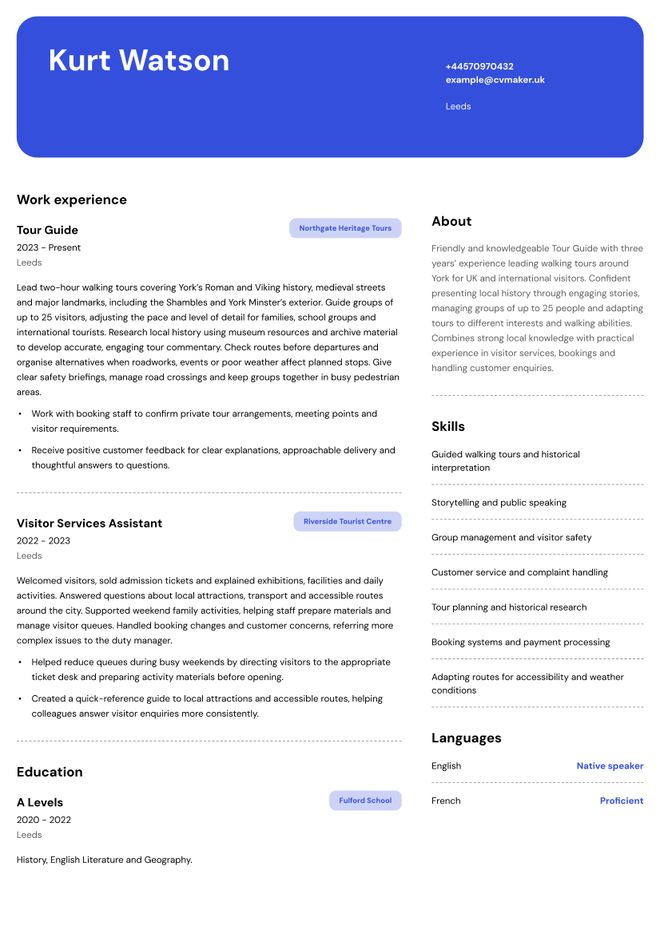
Tour Guide CV example
)
Download this tourist CV example for free in PDF.
What employers look for in a tourist guide CV
Before you start writing, it helps to know what a hiring manager wants to see. Most tourist guide employers look for evidence of three core things:
You can engage and manage groups. You keep people interested, answer questions, and keep everyone together.
You know your subject. This could be a city, a historic site, a museum collection, or a particular theme like food or architecture.
You can deliver safe, organised, and enjoyable tours. You stick to timings, handle problems calmly, and look after your group.
Beyond these basics, employers often value:
Some roles, particularly coach tours or tour management, also look for itinerary planning, language skills, ticketing experience, and health and safety awareness. Read each job advert carefully so you know which of these to bring forward.
How to structure a tourist guide CV
A good tourist guide CV is clear, professional, and easy to scan. Hiring managers often have many applications to review, so make it simple for them to find what they need.
Follow these basic rules:
Use a reverse-chronological format. Put your most recent job first.
Keep it to one or two pages. One page is often enough for entry-level candidates.
Choose a readable font, such as Arial or Calibri.
Use consistent headings and bullet points.
Tailor it to each job. A generic CV rarely stands out.
Here are the main sections to include, in order.
| Section | What to include |
|---|---|
| Contact details | Keep this section short and practical. Include full name, town or city, mobile number, professional email address. You can also add a driving licence if the role involves driving, or your availability if the job is seasonal. |
| Personal profile | Your personal profile sits at the top of your CV, just below your contact details. It's a short summary of three to five lines that explains who you are and what you offer. |
| Key skills | A dedicated skills section helps hiring managers see your strengths at a glance. Pick six to 10 skills that match the job advert. |
| Work experience | This is where you prove what you can do. Don't just list your duties. Show your impact. If you haven't worked as a tourist guide before, don't worry. Experience from museums, hotels, events, education, or customer service can still be highly relevant. |
| Education and training | List your qualifications with the most recent first. Highlight subjects that support the role. |
| Certifications and qualifications | This section can help you stand out, especially for specialist roles. If you hold guiding qualifications, give them their own heading. |
| Languages and additional information | Language skills can make a big difference when you work with international visitors. List each language with a clear level of ability. Tourist guide work is often seasonal or freelance, so flexible availability can be a real selling point. |
How to list tour guide skills in a CV?
The best tourist guide CVs combine soft skills with practical, role-specific abilities. Grouping them helps you think about what to include, and makes it easier to match your skills to the job.
| Hard skills | Soft skills |
|---|---|
| Commentary | Communication |
| Health and safety awareness | Adaptability |
| Local knowledge | Confidence |
| Itinerary planning | Time management |
| Group coordination | Organisation |
| Microphone or audio-guide equipment | Problem-solving |
| Booking and ticketing systems | Customer care |
Pro tip
Don't just list skills. Show them in action in your work experience section. For example, instead of only listing "adaptability", describe a time you changed a route because of bad weather or a last-minute venue closure.
How to write a personal profile for a tourist guide CV
Many people find the personal profile the hardest part of their CV. It's short, but it does a lot of work.
A good CV profile should:
Introduce you quickly. Who are you, and what do you do?
Show your specialism or potential. What makes you a strong fit?
Match the job. Use language from the job advert where it's accurate.
Experienced tourist guide profile example
Engaging and knowledgeable tourist guide with four years' experience delivering walking, heritage, and museum tours to groups of up to 35 visitors. Strong knowledge of London's social and architectural history, with confident public speaking and group management skills. Experienced in adapting commentary for international visitors, families, and school groups. Fluent in English and Spanish, with first aid training and an Institute of Tourist Guiding Green Badge.
Entry-level tourist guide profile example
Friendly and confident tourism graduate looking for an entry-level tourist guide role. Experienced in customer service, public presentations, and supporting visitors from different cultural backgrounds. Strong knowledge of local history and attractions, with the ability to share information in an accessible and entertaining way. Available for weekend, seasonal, and bank holiday work.
Work experience to include in a tour guide CV
Your CV work experience section should show what you achieved, not just what you were asked to do. A simple way to check is to ask: "So what?" If a bullet point doesn't answer that, it needs more detail.
Here's the difference:
Strong
Delivered up to 12 historical walking tours per week for groups of 5–30 visitors, maintaining an average rating of 4.8 out of 5.
Weak
Led walking tours around the city.
The strong version shows scale, consistency, and results.
Tour guide CV work experience example
Tour Guide, Heritage Walking Tours, York
April 2023–present
Deliver up to 12 historical walking tours per week for groups of 5–30 UK and international visitors. Research and present accurate commentary on York's Roman, Viking, and medieval history. Adapt tour content and pace for families, school groups, older visitors, and guests with accessibility needs.Manage bookings, headcounts, ticket checks, and timed entry at partner attractions.
Handle route changes and visitor concerns calmly while keeping tours safe and on schedule.
Maintain an average visitor rating of 4.8 out of 5 across online review platforms.
Example of transferable experience
If you haven't been a tourist guide before, you can still show the right skills. Roles such as museum assistant, hotel receptionist, visitor centre staff, event assistant, or activity leader all have plenty to offer.
Front-of-House Assistant, Riverside Museum, Bristol
June 2024–September 2025
Welcomed and assisted around 150 visitors per shift, giving directions and information about exhibitions. Delivered short introductory talks to groups of up to 20 visitors.Responded to accessibility requests and customer concerns professionally and sensitively.
Processed admissions, memberships, and shop purchases using the museum's booking and payment systems.
Supported evacuation drills and followed visitor safety procedures.
This entry proves public interaction, presenting information, managing visitors, and handling complaints—all core parts of a tourist guide's job.
How to include education in a tour guide CV
List your qualifications in your CV with the most recent first. Highlight subjects that support the role, such as:
Travel and tourism
History
Geography
Archaeology
Modern languages
Hospitality
Drama or performing arts
A degree isn't always essential for tourist guide work. Focus on what's relevant rather than listing every module you've ever studied. If you have a degree, you can add two or three relevant modules, such as Heritage Management or Public History.
Example of a tour guide CV without experience
)
Download this CV example for a tour guide without experience for free in PDF.
If you are writing a CV without experience, focus on transferable skills from retail, hospitality, volunteering or education. Use examples of welcoming customers, giving presentations, organising activities or helping people from different backgrounds. Include relevant language skills, local knowledge and first aid training, if you have it.
Write a personal profile
Explain what you can offer as a guide, focus on transferable skills, your enthusiasm for showing people around historic or cultural sites, and your expertise at planning and organisation.
Example
“Friendly history graduate with experience welcoming customers in a busy York café. Confident speaking to groups and sharing local knowledge, with conversational French and a keen interest in York’s heritage.”
Include additional achievements and projects
This could include anything from school, volunteering or community events that show communication and organisation skills. If you simply enjoy visiting museums or historial sites at weekends, don't forget to mention this as well.
Example
“Welcomed visitors at a community heritage weekend, explained activities and helped groups find their way between venues.”
Mention specific interests
Your enthusiasm and passion for local history, architecture or wildlife, can help you get hired even if you don't have formal experience.
Example
“Interested in York’s medieval history and architecture, with knowledge developed through local history talks and independent research.”
Tailor your CV to the role
Check the job description and company and highlight relevant strengths such as public speaking for walking tours or working with children for school visits.
Example for tours involving school groups
"Supported museum craft sessions for children aged 7–11, explaining instructions clearly and helping them stay engaged.”
Final tips before you send your tourist guide CV
Before you send your CV via email or submit through a job site, run through this quick checklist:
Tailor your CV to each role. Match your skills and examples to the job advert.
Proofread carefully. Double-check place names, dates, and historical references.
Match your emphasis to the tour type:
Heritage tours: local history and subject knowledge
Museum tours: research and presentation skills
Walking tours: storytelling and stamina
Coach tours: logistics, timekeeping, and problem-solving
Adventure or outdoor tours: fitness, safety, and outdoor qualifications
Check your contact details are correct and up to date.
Save your CV as a PDF unless the employer asks for another format.
Above all, remember what employers want to see: evidence that you can engage people, stay organised, and keep everyone safe.
Key takeaways
A tourist guide CV should show you can engage groups, share your knowledge confidently, and keep visitors safe.
Use a clear, reverse-chronological format and tailor your CV to each role.
Include a personal profile, key skills, work experience, education, certifications, and languages.
Back up every claim with evidence. Use numbers where you can.
If you have no direct experience, lead with transferable skills from volunteering, hospitality, or public-facing work.
Mirror keywords from the job advert to help your CV pass ATS screening.
Create your tourist guide CV with CVMaker
Next steps?
A great tourist guide CV shows personality, professionalism, and proof of what you can do. Whether you've led hundreds of tours or you're applying for your first role, you have relevant experience to share. It's about presenting it in the right way.
With CVMaker, you can build a professional, ATS-friendly CV in a few simple steps. Choose from our customisable CV templates, follow the guided process, and create a CV that's ready for your next application. Pair it with a matching cover letter to give your application a polished, consistent finish.
FAQs
Can I apply for tourist guide jobs with hospitality or museum experience?
Absolutely. Hospitality and museum roles build many of the same skills, such as helping visitors, answering questions, and handling complaints. Show these clearly in your work experience bullet points.
What are the best skills for a tourist guide CV?
The most valuable skills include public speaking, customer service, group management, local history knowledge, itinerary planning, and health and safety awareness. Always match your skills to the job advert.FAQ 3
How long should a tourist guide CV be?
Aim for one to two pages. If you're early in your career, one page is usually enough. Experienced guides with several roles and qualifications may need two. Learn more about the ideal length for a CV.
What should I put on a tourist guide CV if I have no experience?
Focus on transferable skills from volunteering, hospitality, retail, education, or public speaking. Highlight your local knowledge, any presentations you've given, and training such as first aid. A short practice tour you've created yourself is also worth mentioning.
Should I include language skills on my CV?
Yes. Language skills are a big advantage when working with international visitors. List each language with a clear level, such as "fluent" or "conversational", and be honest about your ability.
Do I need qualifications to become a tourist guide in the UK?
Not always. Many employers hire guides without formal qualifications, especially for entry-level or seasonal roles. However, Institute of Tourist Guiding badges can strengthen your application and may be expected for some specialist or premium tours.