How to Make a CV for a Nutritionist: Guide for UK jobseekers
A strong nutritionist CV needs to show more than an interest in healthy eating. Employers want to see relevant knowledge, practical experience and the skills needed to support clients, communities or organisations. Nutrition careers can also lead into areas such as public health, sports and exercise, food manufacturing, research and product development.
This guide covers what to include in a nutritionist CV, from writing a focused personal profile to presenting your education, skills and work experience. You will also find nutritionist CV examples for different career paths, advice for graduates with little or no experience, and tips for tailoring a modern CV to different nutritionist jobs.
Note: employers look for CVs that follow an ATS-friendly format and follow these tips to avoid your CV getting overlooked.

Customise this nutrionist CV example
Streamline your CV writing process with CVMaker, featuring intuitive designs and advice on how to choose the best CV template.
Nutritionist CV Example
) Download this nutritionist CV example free in PDF.
Download this nutritionist CV example free in PDF.
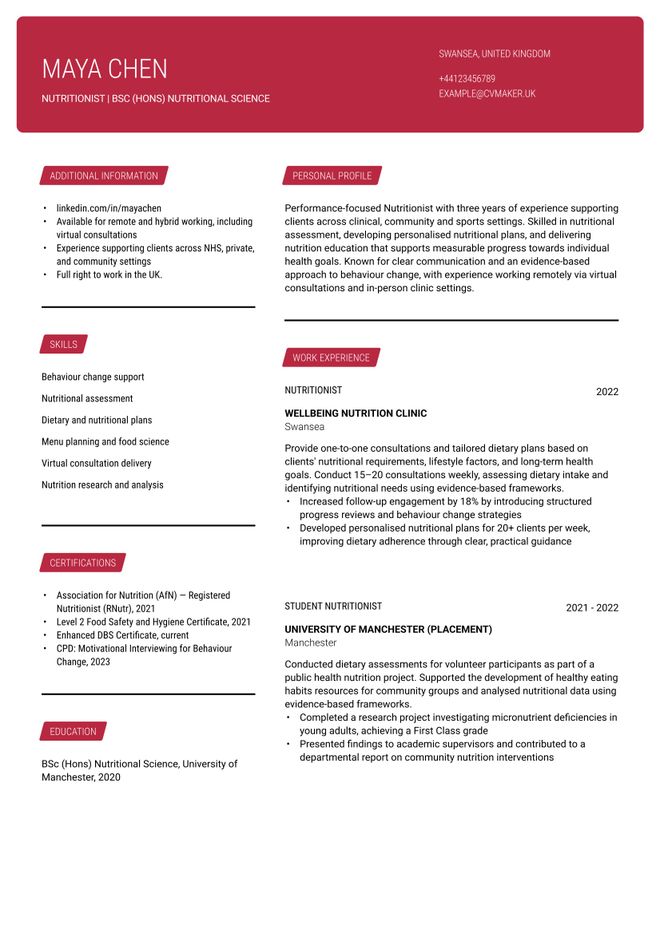
In this nutritionist CV sample, Maya Chen presents three years of clinical and sports nutrition experience in a clear, one-page professional CV. Structured work experience in reverse chronological order, a focused personal profile, and a skills-first layout make this a practical nutritionist CV template for experienced professionals and recent graduates targeting nutritionist jobs in 2026.
What to include in a nutritionist CV
A professional nutritionist CV should give hiring managers a clear overview of your background and suitability for the position. Start with a concise personal profile, followed by relevant work experience, education and key skills.
Before writing your CV, create a master CV including your full career history, qualifications, courses, skills and experience. You can then tailor your CV for individual nutritionist jobs.
| Section | What to include |
|---|---|
| Contact details | Include your name, phone number, professional email address and location. |
| Personal profile: | Summarise your experience, specialist knowledge and strongest qualities in three to four sentences. |
| Work experience | Focus on relevant responsibilities, projects and contributions, using bullet points to keep the section easy to scan. |
| Education | Include relevant degrees, diplomas and qualifications in nutrition, food science or related subjects. |
| Skills | Highlight technical nutrition knowledge alongside communication, coaching, research and organisational skills. |
| Courses and certificates | Add relevant professional development, specialist training or registration. |
Keywords to include for an ATS-friendly nutritionist CV
Many employers use applicant tracking systems (ATS) to organise applications and identify candidates whose CVs match the requirements of a vacancy. Use relevant terminology naturally throughout your CV rather than creating a separate list of keywords and phrases.
Start by reviewing the job description and identifying the skills, qualifications and responsibilities that appear most frequently. Then use relevant terms where they accurately describe your experience. Here are the best keywords to use in your CV for a nutritionist job application.
Examples of nutritionist CV keywords include:
For example, if a vacancy asks for experience developing ‘nutritional plans’, use that terminology when describing relevant experience rather than replacing it with a vague phrase such as “helped clients with food choices”.
How to highlight nutritionist skills in a CV
A strong nutritionist job application should highlight a balance of technical knowledge and people skills in a CV. Choose skills that match the type of nutritionist role you are applying for, rather than listing every skill you have.
Aim for 5–10 relevant skills, using clear bullet points. Review the job description and prioritise skills that employers list, such as nutritional assessment, dietary planning, research, or client education.
5 essential nutritionist skills
Nutritional assessment: reviewing dietary intake and identifying nutritional needs.
Dietary planning: creating practical nutritional or dietary plans based on individual requirements.
Nutrition education: explaining nutritional information clearly to clients or groups.
Research and analysis: evaluating evidence and interpreting nutrition-related information.
Client communication: discussing nutrition recommendations clearly and adapting your approach to different audiences.
Add 2–3 soft skills to your personal profile, supporting them with a brief, specific example rather than a vague claim.
For instance, instead of writing "strong organisational skills", try: "Manage a caseload of 20+ weekly consultations, maintaining accurate client records and follow-up schedules while adapting nutritional plans to individual progress and changing health goals."
| Hard skills | Soft skills |
|---|---|
| Nutritional assessment | Communication |
| Dietary planning | Empathy |
| Nutrition research | Active listening |
| Health promotion | Coaching |
| Food science | Organisation |
| Behaviour change support | Teamwork |
| Menu planning | Problem-solving |
Show hard skills in your work experience
Explain how you used a specific technique or area of knowledge to achieve an outcome. For example, rather than listing “dietary planning”, demonstrate how you applied it:
How to write a personal profile for a nutritionist CV
Your CV personal profile should be 60–80 words and give employers a quick overview of your experience, specialist knowledge and career goals. Avoid broad statements about being passionate about healthcare or nutrition. Instead, be relevant and focus on what you can contribute to the role.
Pro tip
Use the job description to decide which areas of your background to emphasise.
Performance Nutritionist CV example
Performance Nutritionist with 4+ years of experience supporting athletes through evidence-based nutrition strategies and performance-focused dietary planning. Skilled in assessing nutritional requirements, developing individual plans, and working alongside coaches and fitness professionals. Known for a practical approach to nutrition and clear communication, helping athletes understand strategies that support training, recovery, and long-term performance.
Nutrition Advisor CV example
Client-focused Nutrition Advisor with 3 years of experience providing practical dietary guidance and supporting individuals with healthy lifestyle changes. Confident conducting consultations, discussing dietary requirements and adapting recommendations to individual needs. Recognised for clear communication and an empathetic approach when helping clients work towards realistic health goals.
Sports Nutritionist CV example
Sports Nutritionist with experience supporting recreational and competitive athletes through personalised nutrition, hydration and recovery strategies. Skilled in nutritional assessment, dietary planning and client education, with an understanding of performance-focused nutrition. Collaborative and approachable, with experience working alongside fitness professionals to support individual training goals.
Freelance Nutritionist CV example
Freelance Nutritionist specialising in personalised dietary guidance, nutrition education and health-focused content. Experienced in conducting virtual consultations, creating tailored nutritional plans and communicating evidence-based information through digital platforms. Organised and adaptable, with strong client relationship skills and the ability to manage consultations, administration and professional development independently.
How to include relevant work experience for a nutritionist CV
The work experience section in a CV has to show how you apply nutritional knowledge in real settings. List roles starting with the most recent and follow these tips:
Job title of current or previous role
Organisation name and location
Dates of employment (month/year)
A concise paragraph detailing your duties
2–3 bullet points that highlight your key achievements or measurable impact.
Good versus bad achievement examples for work history
Good
Designed personalised nutritional plans for 20+ clients, improving adherence through structured follow‑ups.
Bad
Helped clients with nutrition.
Good
Delivered six community workshops, increasing engagement with practical meal‑planning activities.
Bad
Delivered healthy eating workshops.
Nutritionist CV work experience examples
Nutritionist | Wellbeing Nutrition Clinic, Manchester | 2022–present
Provide one‑to‑one consultations and tailored dietary guidance based on clients’ nutritional requirements, lifestyle factors, and long‑term health goals. Conduct 15–20 consultations weekly, assessing dietary intake and identifying nutritional needs. Develop personalised nutritional plans and monitor client progress using evidence‑based recommendations.
Increased follow‑up engagement by 18% by introducing structured progress reviews and behaviour change strategies.
Sports Nutritionist | Performance Fitness Centre, Sheffield | 2021 - present
Support recreational and competitive athletes with nutrition, hydration and recovery strategies aligned with training demands. Create performance‑focused dietary plans to optimise fuelling, hydration and recovery. Deliver one‑to‑one consultation in collaboration with fitness professionals and coaches.
Improved client adherence by 20% through practical meal‑planning resources and simplified guidance.
Performance Nutritionist | Elite Performance Academy, Leeds | January 2020 - 2022
Provided nutrition support to athletes, focusing on fuelling strategies, recovery protocols and health education. Assessed dietary habits and identified adjustments to support training load and performance goals. Delivered group education sessions for athletes and coaching staff, improving understanding of performance nutrition principles.
Developed a new set of performance‑nutrition resources that were adopted across the academy and used by 40+ athletes.
Nutritionist CV work experience example (little to no experience)
Student Nutritionist | University of Leeds (Placement) | 2025 - 2026
Conducted dietary assessments for volunteer participants as part of a public health nutrition project. Supported the development of healthy eating habits resources for community groups.Analysed nutritional data using evidence‑based frameworks and presented findings to academic supervisors.
Completed a lab‑based research project investigating micronutrient deficiencies. Achieved a First‑Class grade.
How to include education in a nutritionist CV
The CV education section should highlight qualifications that demonstrate your grounding in nutrition, health sciences and public health. List your most recent qualification first, followed by institution and completion date. Include relevant modules that match the job description, such as nutritional biochemistry, public health nutrition, food science, behaviour change, or research methods.
If you’re a recent graduate, strengthen your CV by referencing dissertation topics, research projects or placements involving dietary assessment, nutritional interventions or community‑nutrition work. These help demonstrate practical experience when you have limited professional work experience.
Pro tip
Once you gain industry experience, qualifications such as GCSEs and A levels can be shortened or removed. If you have little to no experience, use a simple CV format or skills-based CV.
How to format educational qualifications
Degree
[Degree title], [Institution], [Location], [Year of graduation]
BSc (Hons) Nutritional Science, University of Leeds, 2026
A-Levels
[Qualification name], [Institution], [Location], [Years completed]
A‑Levels: Biology (A), Chemistry (B), Mathematics (B) Durham Sixth Form, 2023
Tips for writing a nutritionist CV with no experience
If you are applying for your first job, or have little to no nutrition experience, you can still build a strong CV by showing how your education or transferable skills relate to the role.
Use university projects: Include relevant research, dissertations or coursework that demonstrate nutrition knowledge, data analysis or research skills.
Highlight placements and volunteering: find relevant placements, community projects and network to develop practical experience.
Show transferable skills: communication, organisation, teamwork and research can demonstrate your potential when direct experience is limited.
Include relevant extracurricular activities: Sports clubs, wellbeing initiatives or nutrition-related societies can provide evidence of teamwork, commitment or subject knowledge.
Tailor your CV: Match your skills and academic experience to the job description rather than sending the same CV for every role.
Focus on achievements: Use specific outcomes where possible, even if they come from academic grades or university projects.
For more advice, see our school leaver and graduate CVs, suitable for early-career nutritionists. Explore the top soft skills that employers look for in 2026 to boost your application.
Explore related CV examples for inspiration:
Sports CV: useful for nutritionists working with athletes, sports teams or fitness organisations.
Personal Trainer CV: relevant to professionals working across nutrition, fitness and lifestyle coaching.
Healthcare CV: useful for nutritionists targeting health and wellbeing settings.
Research Assistant CV: relevant for nutrition graduates pursuing research, academic or evidence-based roles.
Essentials for a nutritionist job application
Showcase your ability to assess dietary needs, create nutritional plans, and support client health. Highlight any practical experience from clinics, sports settings, community programmes or food‑industry projects.
Include your degree, relevant certifications and any AfN‑aligned training. If you’re applying without experience, use placements, research projects or volunteering to demonstrate employability.
Keep your CV clear, structured and one page, using concise bullet points and measurable achievements.
Dos and don’ts for a nutritionist CV
Dos
Use reverse chronological order and a modern layout.
Tailor your CV to public health, sports, or food‑industry nutrition.
Include relevant courses and certifications.
Add a short disability statement only if it supports reasonable adjustments.
Keep personal details minimal: contact details, location, LinkedIn.
Don’ts
Add a photo; UK employers don’t require one.
Include references unless requested.
Overshare personal information (marital status, age, health conditions or disabilities).
Keyword‑stuff terms like nutritionist CV or repeat skills unnecessarily.
List outdated GCSEs once you have industry experience.
Next steps?
Ready to submit your nutritionist CV? Learn how to structure a cover letter to complete your application. Strengthen your job search with guides on how to send your CV via email and keep track of job applications. Learn how to answer “how do you drive results?” and what not to say in a job interview.
FAQs
What is a nutritionist’s salary in the UK?
Nutritionist salaries vary by sector and experience, with entry‑level roles typically starting at junior band levels and higher earnings available in sports, public health and industry roles. Read more about .
What is the difference between a nutritionist and a dietitian in the UK?
Dietitians are HCPC‑regulated and work clinically; nutritionists focus on behaviour change, healthy eating habits, public health and food‑industry roles. Learn more about a career with the NHS.
Do I need Association for Nutrition registration on my CV?
AfN registration is optional, but adding it to your nutritionist CV can strengthen credibility; you can check eligibility and registration routes on the website.
How do I start my career as a nutritionist?
Begin by gaining practical experience through placements, volunteering or research projects, and use these to create strong, achievement‑focused work experience bullet points. Refer to the for career guidance.
Should I call myself a nutritionist on my CV if I am not registered yet?
You can describe yourself as a Graduate Nutritionist or Student Nutritionist until AfN registration is complete.
How can I turn a nutrition dissertation, placement, or university project into credible CV experience?
Present academic work as practical achievements by highlighting outcomes, data analysis, or real‑world impact, ideal for strengthening entry‑level nutritionist CV samples and showcasing relevant work experience.
How should I tailor my CV for public health nutrition roles versus food‑industry roles?
For public health, emphasise community programmes and population‑level interventions; for food‑industry roles, focus on product development, food safety and regulatory knowledge. Browse and for more information.