
How to Write an Academic Cover Letter with Examples
A strong academic cover letter is a critical part of your application. whether you're applying for a faculty position, a research role, or a postdoctoral fellowship. A good cover letter goes beyond summarising your CV; it gives hiring committees a clear sense of your research interests, teaching experience, and fit with the department.
Unlike a standard cover letter, an academic cover letter is typically longer (one to two pages), more formal in tone, and expected to address your teaching philosophy, research focus, and departmental fit. You may also be asked to submit separate documents such as a research statement or publication list alongside it.
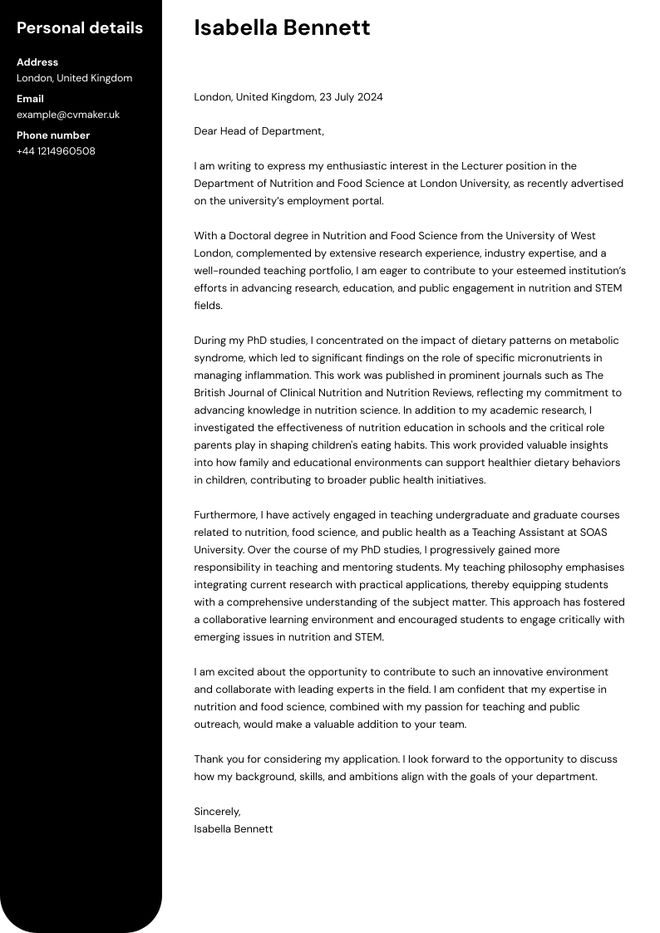
Academic cover letter example
)
Download this academic cover letter examples free in PDF.

What to include in an academic cover letter?
An academic cover letter should highlight your research interests, teaching experience, and qualifications while demonstrating how they align with the role and institution. The sections below explain the key elements to include and how to present them in a clear, professional, and compelling way.
Must-have cover letter sections
Personal details: Include your full name, contact information, and location.
Introduction: Start with a greeting, then provide a concise yet compelling introduction.
Body: Highlight relevant expertise and abilities, incorporating noteworthy achievements if applicable.
Conclusion: Summarise everything into a brief paragraph.
Pro tip
Research the department before writing your cover letter. Mentioning specific faculty members, research groups, or institutional priorities shows genuine interest and demonstrates how your expertise aligns with the role.
How to start an academic cover letter
The introduction of your academic cover letter should be engaging and immediately convey the purpose of your application. Begin by addressing the hiring committee, mentioning the specific position you are applying for, and briefly stating why you are an ideal candidate. This section should be concise and to the point.
When addressing the recipient, use "Dear Prof. [Surname]" or "Dear Dr [Surname]" – do not use first names in a formal academic application.
If the hiring manager's name is not listed in the job advertisement, address the hiring committee directly (e.g., "Dear Hiring Committee" or "Dear Members of the Search Committee").
Avoid "To Whom It May Concern," as it can read as impersonal in an academic context.
For more tips, refer to how to start a cover letter.
Academic advisor cover letter example
I am writing to express my interest in the Academic Advisor position at the London School of Business, as advertised. With 5 years of experience in student counselling and a passion for supporting academic success, I am eager to contribute to your institution’s mission of guiding and mentoring students towards their educational goals.
Assistant professor cover letter example
I am writing to apply for the Assistant Professor position in Economics at Brightstone University, as advertised. As a recent PhD graduate from Eastford University, with a focus on Macroeconomics, I am eager to bring my passion for economic research and my dedication to teaching and research to your esteemed department.
Lecturer cover letter example
I am writing to express my interest in the Lecturer position in Psychology at London University, as advertised. With 10 years of experience in teaching and research in psychology, I am excited about the opportunity to contribute to your department’s mission of academic excellence and student engagement
How to write the body of an academic cover letter
The body of your cover letter should provide a detailed account of your qualifications, focusing on your research, teaching experience, and any relevant achievements. This section is usually divided into two to three paragraphs, each highlighting different aspects of your professional background.
Many UK universities use an applicant tracking system (ATS) to screen applications before they reach a hiring committee. To improve your chances of passing this initial stage, consider the following:
Mirror keywords from the job description, such as "curriculum development," "student engagement," or "research methodology", where they genuinely reflect your experience.
Where possible, quantify your achievements: student satisfaction scores, the number of publications, or grant funding secured all add weight to your application.
Your teaching philosophy and research statement are often submitted as separate documents alongside your cover letter; the body of your letter should reference these and briefly connect them to the department's priorities.
There is no one-size-fits-all cover letter strategy, but for more tips, check out our article on cover letter structure.
3 cover letter examples
1. Academic advisor cover letter example
In my current role at Manchester University, I have successfully advised a diverse student population on academic planning, career development, and personal growth. My strong interpersonal skills and commitment to student advocacy allow me to foster meaningful relationships with students, helping them navigate challenges and make informed decisions.
I am impressed by London Business School’s dedication to student excellence. My background in student affairs and counselling aligns well with the needs of your advising team. I am excited about the opportunity to support students and contribute to its vibrant academic community.
2. Assistant professor cover letter example
During my doctoral studies, I conducted innovative research on economic growth and income inequality, resulting in several publications in renowned journals such as the Journal of Economic Perspectives and Economic Inquiry. My dissertation, “The Dynamics of Income Inequality and Economic Growth in Developing Economies,” received the Eastford University Best Dissertation Award for its significant contributions to the field.
I have experience teaching undergraduate and graduate courses in Macroeconomics, Microeconomics, and Econometrics. In my role as a teaching assistant and later as an adjunct lecturer at Eastford University, I developed and delivered comprehensive course materials that fostered a deep understanding of complex economic theories. My ability to engage students and promote critical thinking was consistently reflected in my high student evaluation scores and positive feedback
I am particularly drawn to Brightstone University because of its commitment to research excellence and interdisciplinary collaboration. I am excited about the opportunity to contribute to your department’s academic community through my research, teaching, and service. I am particularly interested in collaborating with faculty members on projects related to economic development and policy analysis, and I am eager to engage with students through mentorship and advising.
3. Lecturer cover letter example
In my current role at Greenfield Institute, I have developed and taught courses in cognitive psychology, developmental psychology, and research methods, receiving positive feedback from students for my enthusiasm and ability to create an inclusive learning environment. My commitment to student-centred learning and evidence-based teaching practices aligns well with the teaching goals at London University.
I am impressed by the University’s dedication to teaching innovation and research excellence and believe my teaching experience and passion for psychology make me a strong candidate for this position. I am eager to bring my skills and dedication to your department and contribute to its academic community.
Pro tip
Focus on evidence rather than listing responsibilities. Use specific examples of your research, teaching, publications, grants, or student outcomes to demonstrate your impact and academic achievements.
How to end an academic cover letter
Similar to the above, this section is of equal importance. It should summarise your interest in the position, reiterate your enthusiasm, and thank the committee for considering your application. In addition, consider mentioning any enclosed documents such as your CV, references, or perhaps a separate document for additional publications, and express your willingness to provide further information if need be. For more tips, refer to how to professionally sign off and end a cover letter.
Example
In conclusion, I am very enthusiastic about the possibility of joining the Department of Biology at Cambridge University. I am confident that my research background, teaching experience, and commitment to community engagement make me a strong candidate for the Assistant Professor position. Thank you for considering my application. I have enclosed my CV, research statement, and teaching philosophy for your review. I look forward to the opportunity to discuss my application further.
Key takeaways
Tailor the letter to the specific position and institution, demonstrating departmental fit and an understanding of the institution's research priorities.
Highlight your teaching philosophy and how it aligns with the department's approach to learning.
Clearly articulate your research interests and how they complement or advance the department's current work.
Reference any enclosed documents—such as a research statement, teaching philosophy, or publication list—within your conclusion.
Address the hiring committee or named recipient correctly, using formal academic titles (Prof. or Dr) throughout.
For early-career applicants, aim for one page; more experienced candidates may extend to two pages, which is standard for UK academic applications.
Next steps?
With your academic cover letter complete, review your application to ensure your CV, supporting documents, and cover letter are tailored to the role and institution. For more guidance, explore our career advice articles on preparing for interviews, following up after an application, and accepting a job offer to help you through every stage of the application process.
FAQs
Are academic and PhD cover letters the same?
Academic and PhD cover letters are similar but not identical. Both should detail your qualifications and research experience, but a PhD cover letter might focus more on your dissertation work and its relevance to the position. Academic cover letters often address teaching experience and fit with the department.
How do I write a cover letter for an academic application?
Begin with a strong opening stating the position you're applying for. Follow with a brief overview of your academic background and research achievements, then align your expertise with the job requirements. Conclude with your enthusiasm for the position and your readiness for an interview.
What is the best academic cover letter template?
A good academic cover letter template includes: an introduction specifying the position you're applying for, a brief summary of your qualifications and research interests, a description of how your experience aligns with the job requirements, and a conclusion expressing enthusiasm for the role and your availability for an interview.
How long should an academic cover letter be?
An academic cover letter should be no more than two pages long. Aim for clarity and conciseness to make a strong impression without overwhelming the reader. Refer to our guide that delves into the ideal cover letter length.
Does a cover letter benefit someone in academics?
Yes, a cover letter is crucial in academics as it highlights your suitability for the position, complements your CV, and provides context for your achievements and research interests.
Is a cover letter required for academic positions?
Yes, a cover letter is typically required for academic positions. It provides an opportunity to discuss your qualifications in more detail and explain why you’re a good fit for the role and institution.
Do you need a cover letter for a research position?
Yes, a cover letter is important for research positions. It allows you to explain your research background, how it aligns with the position, and why you are interested in the role, making your application more compelling.
How does an academic cover letter differ from a standard cover letter?
An academic cover letter is typically longer than a standard cover letter – one to two pages – and more formal in tone. It goes beyond outlining skills and experience to address your research interests, teaching philosophy, and departmental fit. You will also be expected to reference any enclosed documents, such as a research statement or publication list, which are not standard components of a general job application cover letter.